
AI can now take on work that used to need people to interpret information and coordinate with each other. We'll help you bring it into your business without disrupting what already runs.

Trusted by teams at Bootbarn, NOV, Spirent, and others.


AI can cut the cost and time of getting work done by multiples, not percentages. It can also raise your team's capacity and the quality of the work.
The companies that build AI into their daily operations first can compete on cost, speed and scale that a business run the traditional way can't match.
Once AI-native competitors reset what customers expect on price and speed, catching up gets much harder. Anyone can buy the same models and tools. The advantage goes to the company that redesigns how work moves through its business until AI can carry it out reliably.
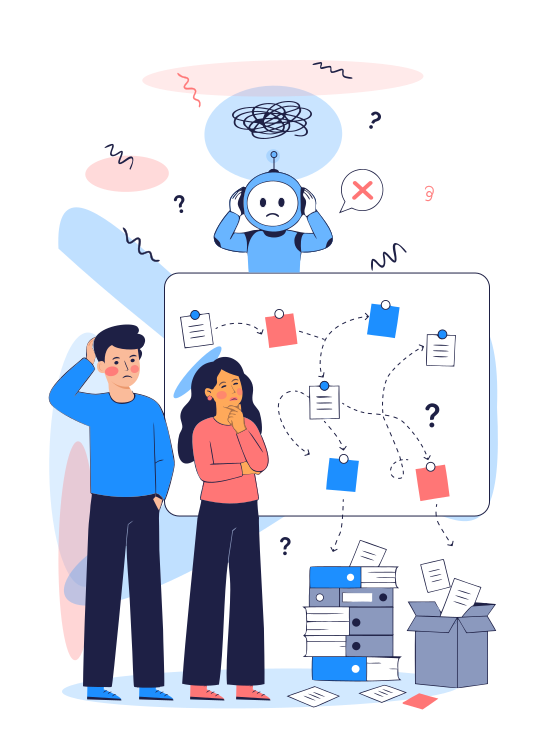
Between the steps of a process, the important context often lives in people's heads, and documents carry only fragments of it. When AI hits those gaps, it starts making things up. Results change from one run to the next, and every automation needs more fixing than anyone planned.
"Where can we add AI?"
This question leads to separate features and pilots. Each may work on its own, but the way the business runs stays the same.
"How should this part of the business run when AI does some of the work?"
We first describe how the business should run with AI, then work backward from there. We define the process step by step, connect the knowledge and systems it relies on and add automation in stages.
We don't rush to agents. Each stage tests the process, shows what context is still missing and tightens control before AI gets more of the work.
Autonomy grows under control, and it doesn't remove people. AI raises what the same team can deliver, while your professionals keep the judgment and the authority.
AI tools change fast, and no one can predict which vendor will lead in each area. We design around how your business runs. Platforms and models can then change without rebuilding the business.
These are the assets that make AI reliable, and they stay with your business. We build them first, then connect them to the tools that fit each stage. A tool is one part of the system, and you can replace it.
You can start with one use case. For us, it's the first step on a longer path.
The hard part starts when automation crosses departments, legacy systems, decisions, knowledge sources and quality requirements. Then strategy, process design, technical architecture, implementation and adoption have to move together.
We take responsibility for the whole path, from the target operating model to automation running under supervision. Where you start depends on what's blocking progress today.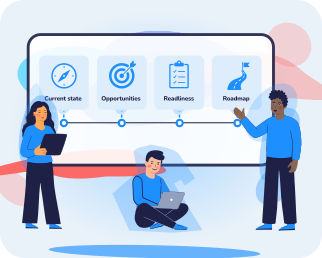
Without a clear target state, AI initiatives scatter across teams, tools and one-off use cases. Define how your organization should run with AI and the prioritized path that gets you there.
Start with Strategy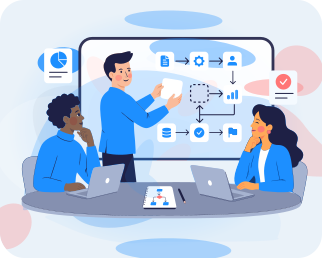
AI can't reliably run a process that is unclear, inconsistent or built only for people. Map your workflows and redesign them to run faster, with more of the work automated.
Redesign a Process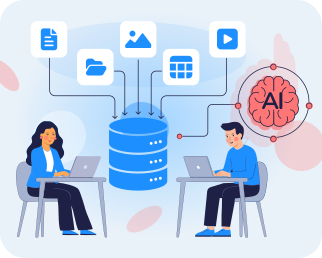
AI can't use expertise it can't reach. Structure and connect the knowledge, rules and business context AI needs to do the work right.
Build the Knowledge Layer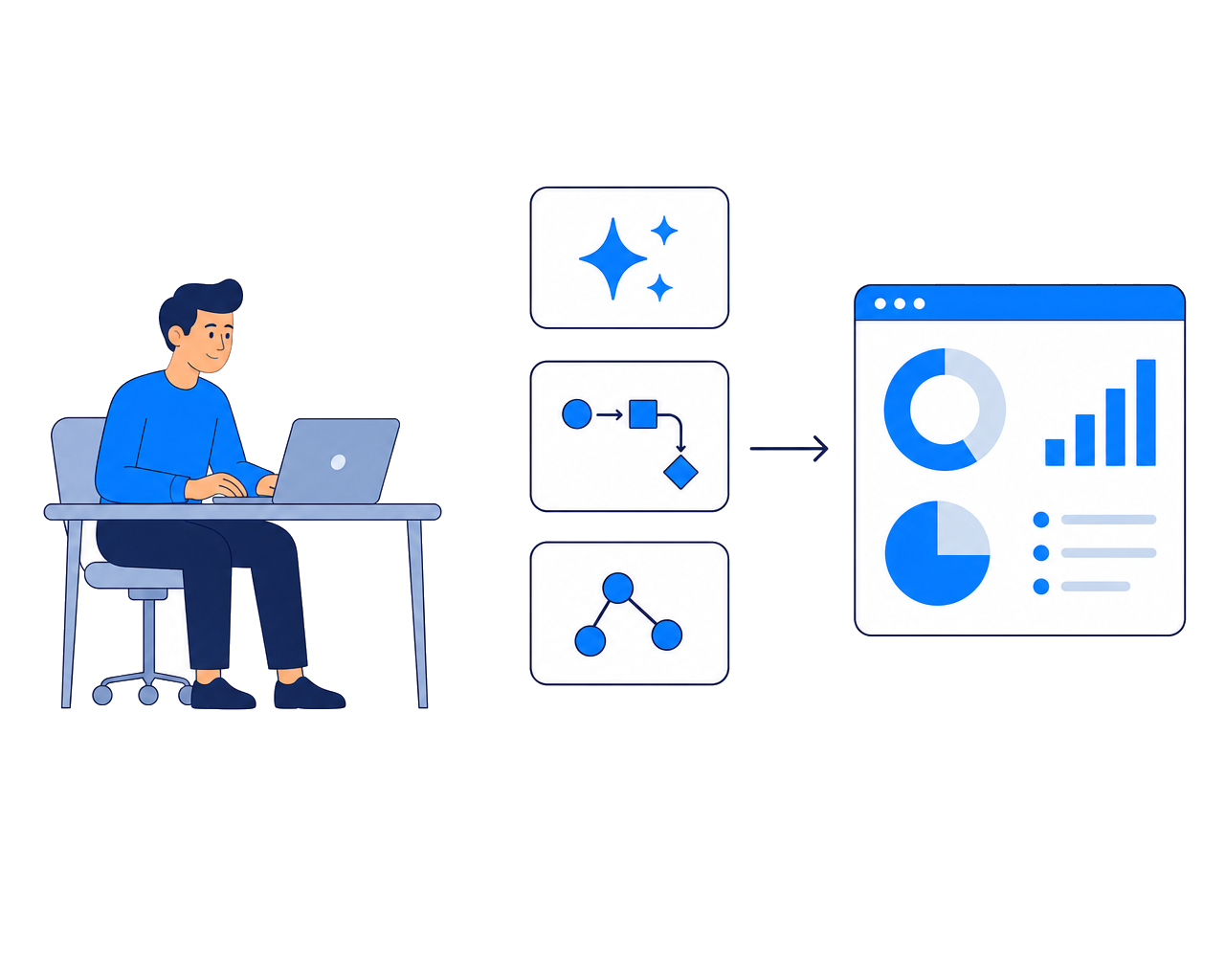
Make repeated AI-assisted work reusable. Package the instructions, knowledge, inputs and outputs that already work into AI skills and producing assistants your team can use on demand.
Make Work Reusable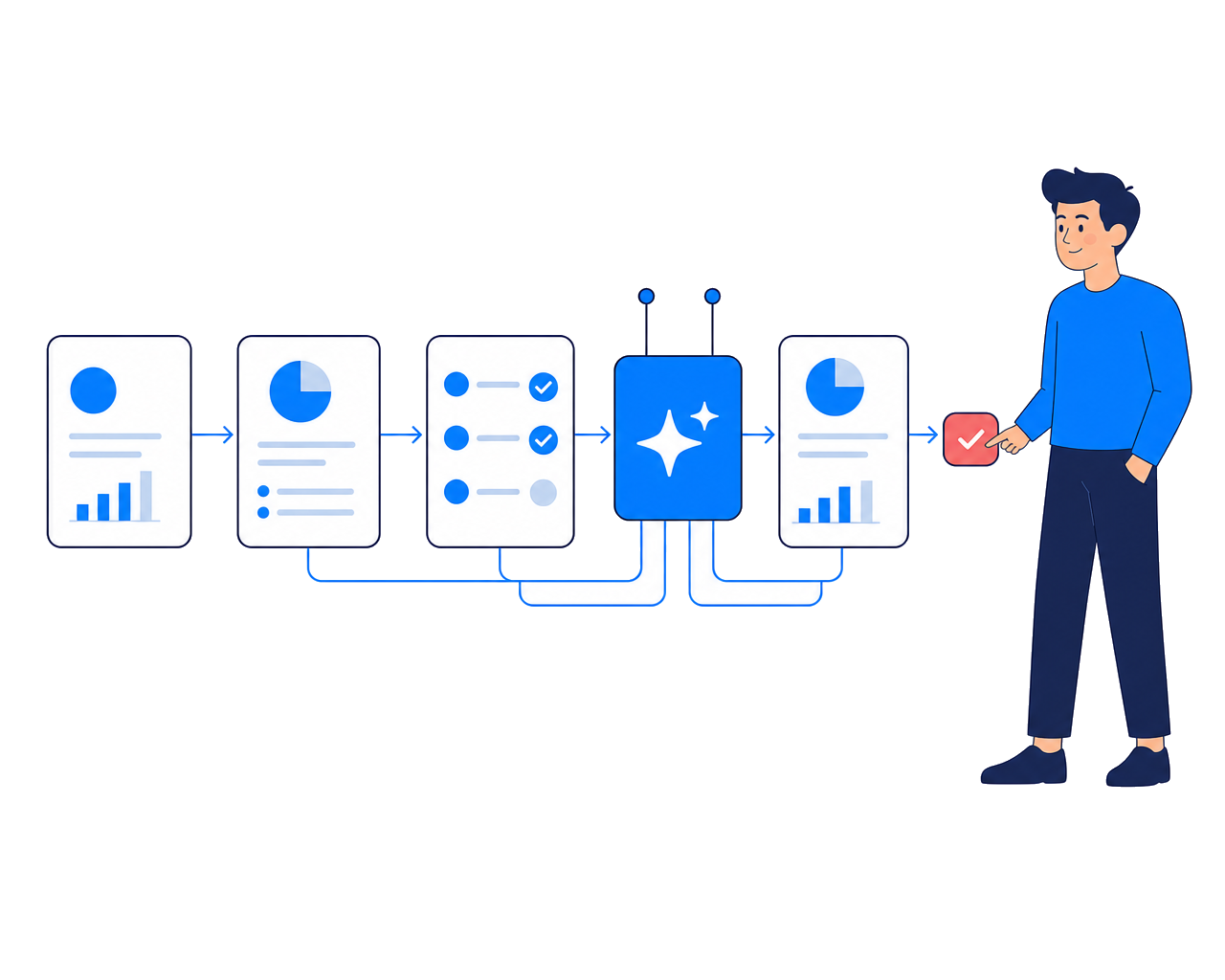
Move defined business processes from human-driven to AI-driven execution. Deploy AI agents that carry multi-step work forward, use your business knowledge and systems and bring in people only where judgment, approval or authority is needed.
Automate a Process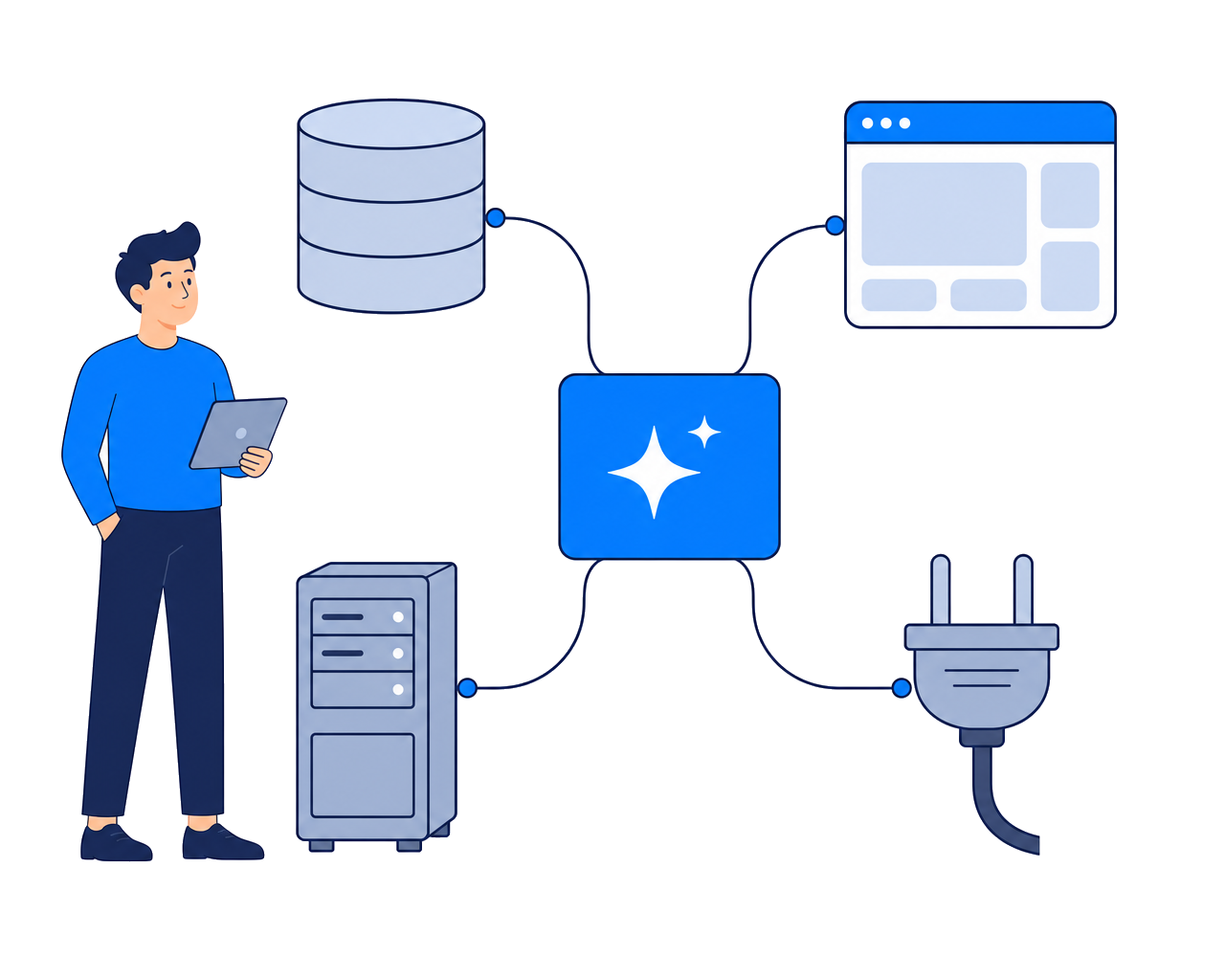
Work stalls when AI can't reach the systems your business runs on. Give agents direct access to the data and actions they need in modern, legacy and custom applications.
Connect Your Systems
Grow the work AI does without growing the supervision it needs. Build measurable quality checks, action controls, automatic correction and exception handling into the workflow itself.
Add AI Controls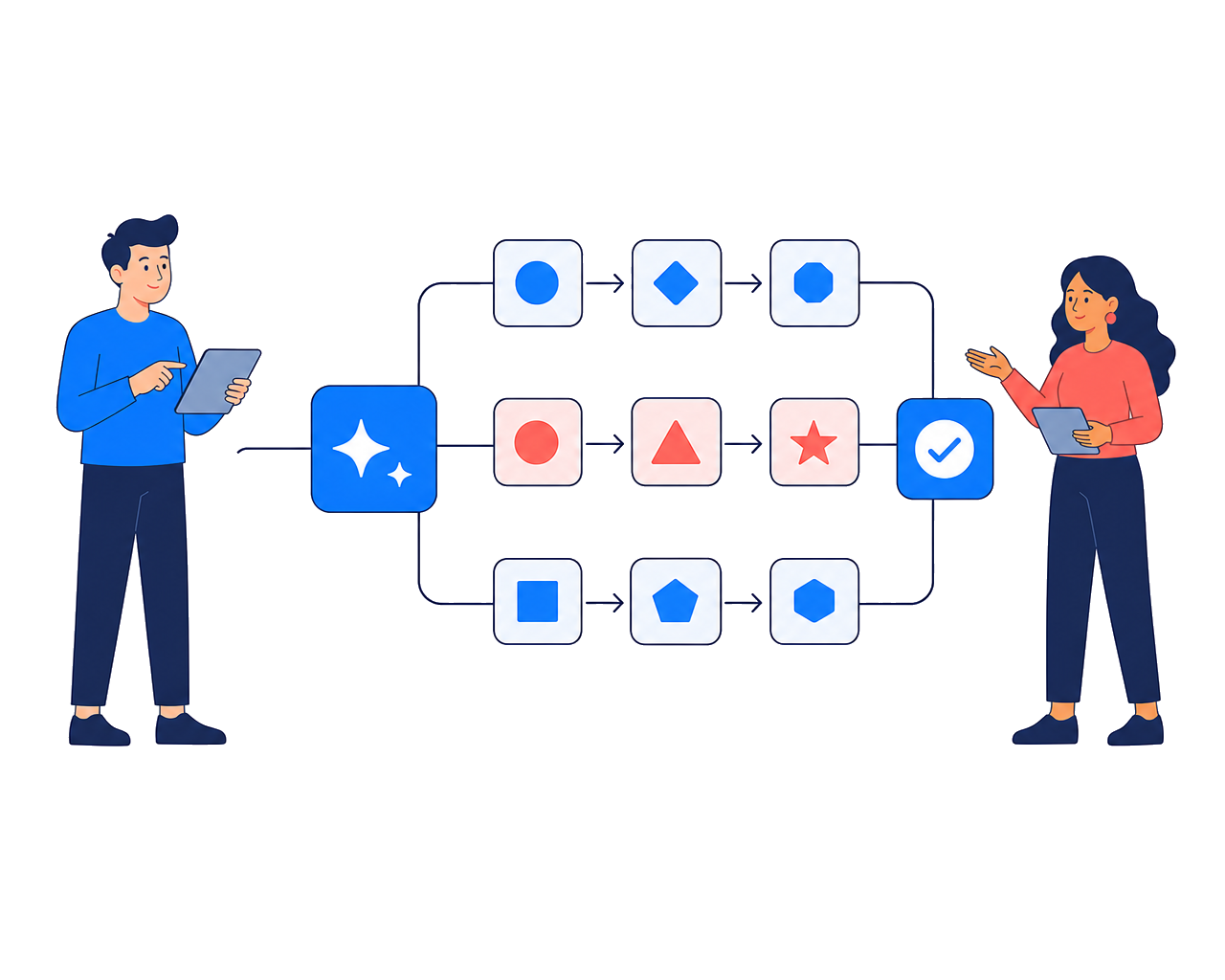
As agents, systems, workflows and parallel tasks multiply, coordinating them becomes the next bottleneck. Build an orchestration layer that turns a complex goal into coordinated work you can see and control.
Orchestrate Execution
Build controlled AI workflows that cut manual effort, connect your systems, check their outputs and grow from assisted work toward more autonomy.
Build an AI Workflow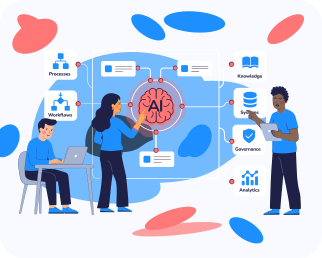
For organizations ready to transform end to end, we bring strategy, processes, knowledge, execution, connectivity, validation, orchestration and adoption under one roadmap.
Discuss Full TransformationMost providers cover one part of the problem: a strategy, a platform, an integration or an automation. You're left to connect the rest.
As a business process automation company, we bring strategy, process design, knowledge engineering, implementation and adoption together. We build around the operations and systems you already have and keep the choice of technology open as the market changes.

One accountable partner from strategy to adoption
Consistent, predictable results instead of trial and error
The platform and model of your choice
AI engineering and business process expertise in the same team
A plan that starts from the end goal and works backward
Automation paired with verification and escalation
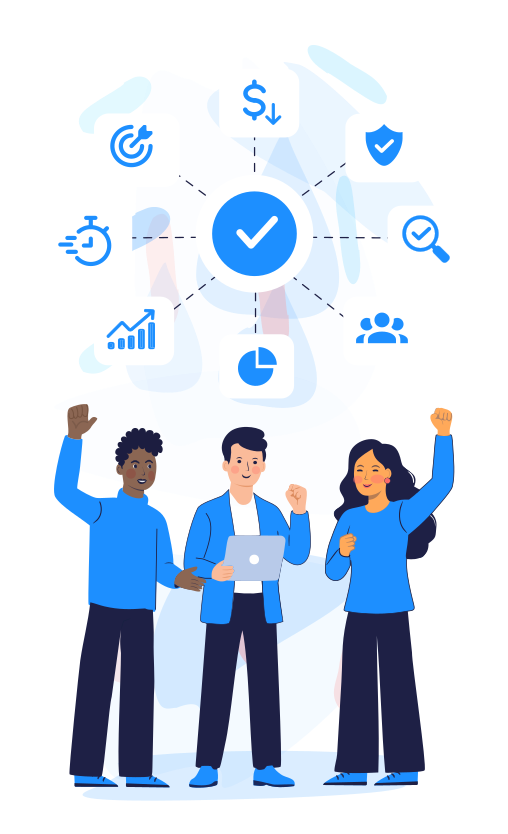
Our business process automation services give you automation running in production on your real processes and knowledge. Your team gets the training to run and supervise it, and we keep supporting it as processes, systems and AI platforms change.
More work gets done without operating costs growing at the same rate.
Decisions turn into finished work and customer deliveries sooner.
The work is done consistently, based on your best processes, knowledge and controls.
AI raises what each person can deliver, and people spend more of their time on judgment, relationships, innovation and growth.
Business process automation means running a repeatable business process through software instead of having people coordinate it step by step. Traditional software could automate only the well-defined parts of a process, the steps with fixed rules and structured data. The parts where someone has to read, interpret, decide and act stayed with people. AI covers those parts for the first time. The whole cycle of a process, from taking in information to acting on it, can now run through software. That's why the cost and time of the work drop by multiples rather than percentages. Automating this way also needs a different approach from adding features to an old system. The process, its knowledge, its decisions and its controls are defined first, and the software carries out that definition.
RPA (robotic process automation) replays fixed rules and clicks. It handles only the cases that match its script, the same partial automation traditional software has always offered. AI-powered process automation is pattern-based and goal-driven. Given an explicit goal, the business context and the quality criteria, it handles variation in documents, requests and cases and routes unclear ones to a person. This matters because the variable, knowledge-heavy part of a process, the part rules never reached, is where delays and manual effort pile up. We use both where each fits. Rule-based tools and system interfaces perform the mechanical actions, and AI interprets and decides. Because the process definition belongs to you, either side can be replaced without rebuilding the process.
Process automation software runs defined workflows across business systems. It includes workflow engines, robotic process automation tools, low-code platforms and now agent platforms, the building blocks that process automation solutions are made of. These platforms provide components. They don't redesign how the business operates, and a workflow that was never defined gives them nothing to follow. In our experience, the long part of automation is defining the process, its instructions and its artifacts. Once that's done, building skills, assistants and agents on a platform is largely mechanical. That's why we treat the platform as a replaceable component and the definitions as the asset. Those definitions are what you keep: defined processes, structured company knowledge, explicit decision and exception logic, quality criteria, connections to your systems and governance for access, cost and risk. Use the platform of your choice and change it later without starting over.
Start from what's blocking progress today. The right entry point depends on where your business is now. If AI activity is spread across teams with no shared target, start with AI Organization Strategy and define the target state first. If a valuable workflow runs on memory and individual judgment, start with AI Process Reengineering. If AI lacks your company's context, start with AI Knowledge Base. If a process is already clear, repeated and valuable, it can be automated directly with AI Process Automation. The order matters. A foundation you skip comes back during implementation as rework, and corrections cost more at that point. Each service is sold separately. A free consultation is enough to find the first constraint and sketch a path forward, with no obligation.
The best candidates are the processes where the business effort, money and errors concentrate, as long as today's technology can carry them reliably. We rank candidates from the business side first: which tasks take the most effort, where the most money goes and where the most mistakes happen. Then we check whether current AI can do the work and how ready the process, the knowledge and the systems are. Choosing on both sides avoids the usual pattern of bolting features onto whatever looks easy. That work often brings little and is later thrown away. A good first unit is a few closely related processes in one problem area. It can sit in any of the domains we automate: administration, HR, IT, finance, sales and marketing, customer support, service delivery, supply chain and warehousing.
No. The aim is to let the same team deliver more, faster and with more consistent quality, and to grow the business without growing staff at the same rate. Routine tasks move to AI, while people direct the work, supervise the results and keep the decisions, approvals and exceptions. As automation matures, some workflows run end to end with an escalation path built in. People's attention then shifts to customers, judgment and improvement. We hold this line for a practical reason as well as a human one. Automation that removes the people who carry the expertise also removes the knowledge it depends on. Capacity is one of the four results we measure, next to cost, speed and quality.
The four stages of AI autonomy are Assisted, Collaborative, Supervised and Autonomous, and each one has a purpose. Assisted: people run the process with a generic AI chat and its instructions; its purpose is to validate the process itself. Collaborative: the proven instructions are wrapped into skills and assistants that a person works with about half and half; its purpose is to work through the cases outside the main flow. Supervised: an agent owns the result and escalates what it can't handle, and a person supervises; its purpose is to catch outliers and define the quality standards. Autonomous: with quality criteria written as checklists or good and bad samples, production agents do the work and verification agents check it. People no longer review each result, but they keep watching how the work performs and handle the exceptions. Areas of a business sit at different stages at once. A stage is extended only after the one before it gives a consistent result, because an agent launched too early produces poor work faster. Our blog describes the same ladder as Levels 1 to 4 of AI automation, each with a minimum quality bar.
It's for mid-size companies and business units of larger organizations that have complex, knowledge-intensive processes and no internal team to engineer AI execution. It's also for smaller firms that want to grow without adding staff at the same rate. The work can cover one problem area, a department or, for a smaller organization, the whole company. We serve software development, commerce, telecom, logistics, manufacturing, mining, the cable industry, oil and gas and digital consulting. For a company this size, juggling separate vendors for strategy, process, knowledge, automation and adoption is a real cost. One provider that can do all of it, without disrupting what already works or tying you to a vendor, is part of the value. A single use case is a good place to start, and we treat it as the first step of a path.
They should cover everything a process needs to run on AI, beyond the software itself. It starts with a strategy that picks which processes to automate first and a redesign of the process. Then come the company knowledge AI works from and the connections to your systems. On top of those sit the assistants and agents that do the work, with checks and escalation rules that keep the results reliable. A tool bought on its own leaves the old process in place, along with its cost and quality problems. We sell each part as its own service and as one connected program, AI Agency Transformation, and we start where the pressure on your operations is greatest.
Tell us how your business runs and where the pressure is. We'll show you where AI could add value and what a practical path forward could look like.