
We define how your organization should run with AI and assess its AI readiness today. Then we work backward into a phased AI roadmap, ordered by business value and technical feasibility.

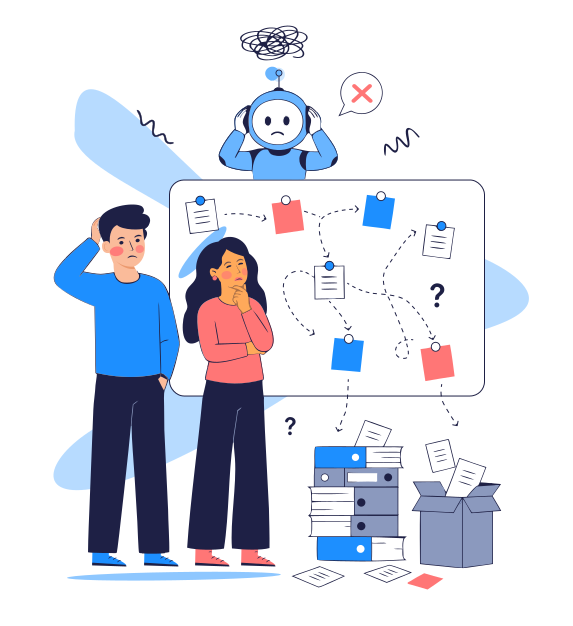
Teams buy tools, launch pilots and automate whatever looks easiest. If no one has defined where the business should end up, even a successful project can pull the organization further away from a coherent way of running.
A useful strategy ties the target operating model to today's business priorities. It also keeps rechecking what technology makes possible.
Our AI strategy consulting answers where the organization is going, where it stands now and what should happen in what order.
How the business runs today across functions, workflows, knowledge and systems. It also shows which process, governance and adoption gaps have to be closed before implementation.
The AI operating model for your priority operations: how they should run once AI is built into the work, and where people keep judgment and authority.
Which areas can cut cost, speed up work, raise quality, add capacity or create a strategic advantage.
An AI implementation roadmap that says what to do now, what to prepare next and what should wait until business need and technical feasibility line up.
Separate pilots stop competing for the same budget, and money goes to the highest-value opportunities first. The business moves toward AI-native operations without interrupting what already works.
It's for organizations scaling AI without a clear strategy and for business units running AI initiatives in isolation. It also suits the executives responsible for putting AI to work across operations.
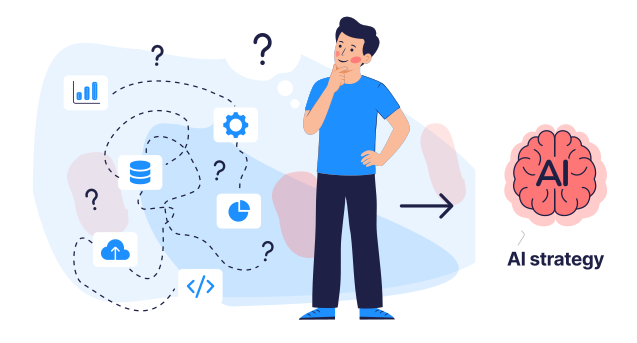
AI activity keeps growing, but without a target state the business doesn't move any closer to a better way of running.
With the strategy, every initiative has a reason and a place in the sequence. You also decide up front what has to be ready before implementation starts.
We work in three stages to find the most direct practical path forward.
Map how the organization runs today: its operating model, workflows, knowledge, systems, manual effort, bottlenecks and existing AI activity.
Describe the AI-native organization: how work should flow, what AI should do, where people supervise and which business results should improve.
Work backward from the target and put the initiatives in order by business value, technical feasibility, risk, readiness and dependencies.
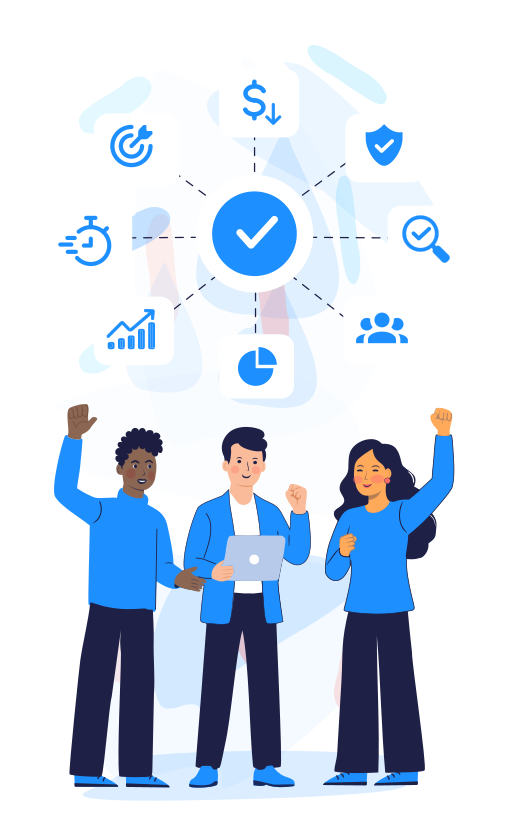
Your budget goes to the operating problems with the strongest business case.
Business, operations and technology teams work from the same plan and know what comes next.
Separate teams no longer solve the same problem in ways that don't fit together.
The business direction holds while the implementation path changes with AI capabilities.
A business AI strategy is a path from where the organization stands today to a defined target state in which AI does a large share of the work. The steps are ordered by business value and technical feasibility. It has three parts: a model of the organization as it runs now, a blueprint of the target operating model and a phased roadmap with decision gates. Without a strategy, adoption goes bottom-up. Teams bolt on a chat here and an AI feature there with no answer to "what for", and every new tool adds complexity without changing how the business operates. Transformation takes time and resources, and a strategy keeps that effort from burning money without results. Ours is built on business needs rather than on today's tools. The implementation path can change with the technology while the strategy holds.
An AI readiness assessment is a review of whether the business can run AI inside its operations, done as part of the current-state analysis. We look at four things. Is the information AI would work from structured, current and easy to find? Are the priority processes defined and repeatable, or do they vary by person? Can AI reach the systems involved? Does the organization agree on what AI should accomplish? On top of that, we check quality criteria, ownership and controls. Two gaps show up almost everywhere: knowledge that exists only in people's heads or in stale documents, and processes that exist but were never designed for AI. It pays to find them before implementation. They don't disappear, and they come back as rework in the middle of a build, where each correction costs more. A free AI readiness checklist gives the quick first look.
We do three things, in this order. First, we analyze in detail how the business works now. That covers its scope, business capabilities, functions and operations, the knowledge each one depends on, the systems and information sources and what is already automated. Second, we draw the target blueprint. It shows how the same business runs when its operations go through AI, which roles stay with people, where unique knowledge and judgment sit and which decisions and control points must stay explicit. Third, we build a roadmap that orders the change by business value and technical feasibility, with decision gates. You receive an organization model, an AI-native blueprint and a phased roadmap, wrapped into an implementation strategy. Tool-led advisory works forward from a product. We start from the end and work backward, and modeling of this kind is rare on the market.
An AI operating model describes how the business runs when AI is part of execution. It says which work AI performs, which decisions and control points stay with people, where the company's unique knowledge and value sit, how quality and risk are controlled and who owns each part. We define it from business needs, not from the technology available this year. That matters because AI technology changes faster than plans can be written. Nobody can predict which vendor will lead in which area, and a model tied to a platform goes stale with it. An operating model built on what the business needs stays valid while the implementation path underneath it flexes, taking the best tools at each step without lock-in. The practical result is confident execution: you know what you do this month, next year and in five years.
We prioritize AI use cases by business value first and technical feasibility second. On the business side we ask where the effort is heaviest, where the most money goes and where the most errors occur. On the technology side we ask what today's AI can carry reliably and what the process, the knowledge and the systems are ready for. Each next milestone is the one that scores on both. This matters because the alternative is familiar. Teams add features that look easy, discover process problems after the budget is spent and later throw the work away. A sequence chosen this way reaches the end point by the straightest path with the least wasted effort, and it stays open to rechecking as technology moves.
The first phase formalizes the processes and knowledge that the first priority area depends on. That means what people do today, which documents and methods they use, where information is lost between steps and what AI will need to know. This preparation is useful right away. People can follow the formalized process with AI support and get a consistency and repeatability they didn't have. The preparation also shows what is still unclear before any agent is built. Automation then grows area by area: assistants and skills, connectors to the systems involved, and agents only where the earlier stages already produce a consistent result. The roadmap sets the readiness gate each phase must pass.
Yes, if the pilots multiply without a shared target. Tools handed out without a workflow give results that are good one day and poor the next, because each person prompts differently and nothing is defined. A chat bolted onto a product with no answer to "what for" does the same. A strategy decides which pilots deserve investment, which should stop and in what order the rest scale. Teams stop solving the same problem with incompatible tools, and leadership can connect AI spend to operating results. Existing pilots aren't wasted. They become evidence in the current-state analysis of what works, what people skip and what the organization still has to prepare.
We take a problem area and first describe what it looks like when it is automated as fully as it can be. That means which work runs through AI, where people direct and supervise and which decisions stay explicit. Only then do we map the current state and build the path between the two. The usual approach runs the other way. It asks "where can we add AI?" and produces isolated features that leave the operating model unchanged. Starting from the end matters because it gives every initiative a reason and a place in the sequence, and a target defined by business needs holds while technology changes. The path doesn't disrupt the business. It builds on what already works instead of throwing it away.
Define the organization you want to build and find the opportunities that matter. We'll turn them into a phased roadmap your teams can carry out before the next wave of AI investment.