
We build AI agents that carry defined workflows forward and use your business knowledge and systems. People step in only for exceptions, approvals and judgment.
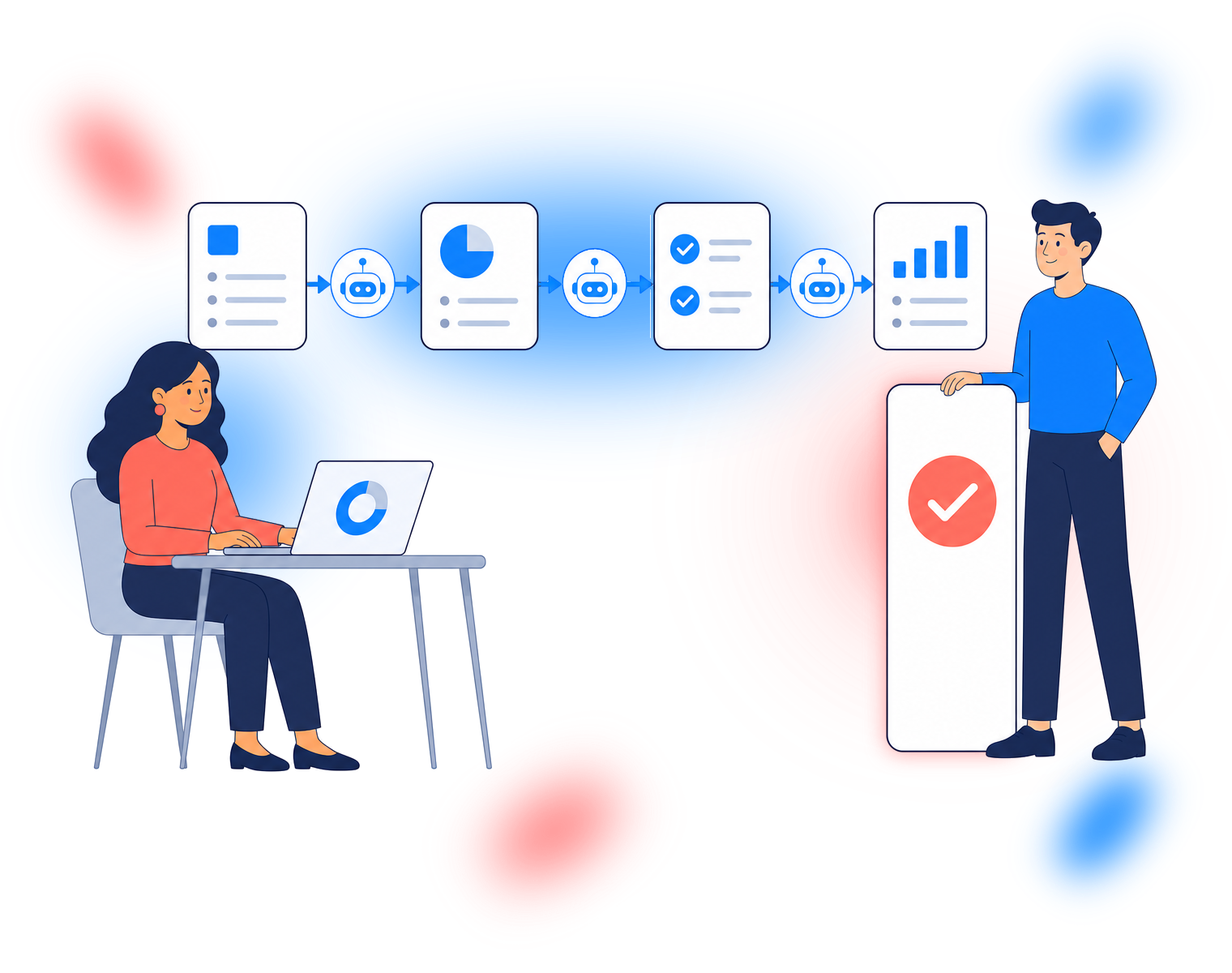
AI may already handle individual activities, but your people still put a lot of effort into starting, moving, supervising and finishing the overall process.
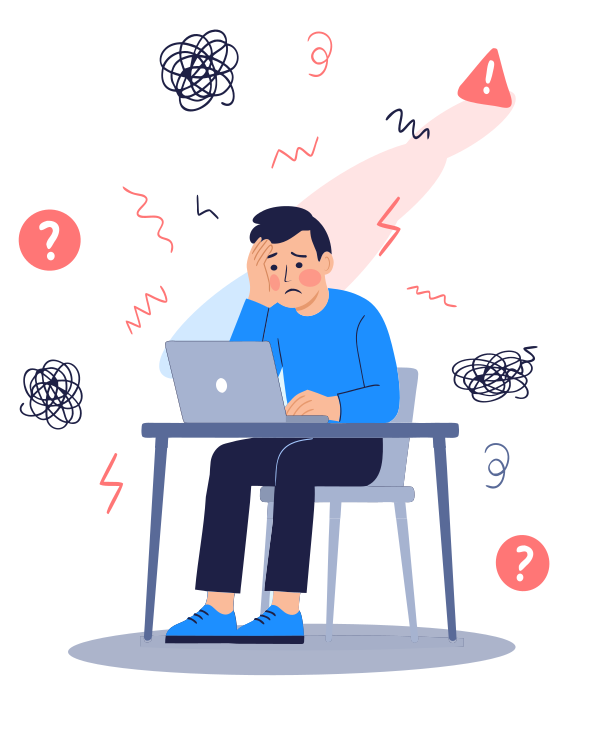
Instead of using AI only when a person asks for the next task, give an AI agent responsibility for a defined area of execution. The agent gets a goal, operating context, allowed actions, completion conditions and clear boundaries. It moves the work through the required steps, uses the available knowledge and systems and decides what happens next. It continues until it reaches the objective or a defined human checkpoint.
We design and develop AI agents around the actual business process. Our AI agent development starts with the work itself: the desired outcome, workflow, information, decisions, systems, rules, responsibilities, exceptions and completion conditions. Then we build the execution capability that work needs.
Agents work toward defined business outcomes instead of waiting for instructions at every step. They know what they are responsible for, what counts as progress, which resources they can use and when the work is done.
An agentic workflow can carry work across a sequence of activities instead of automating one isolated task. The agent keeps the context of the workflow and moves on as intermediate results come in.
Business work often runs beyond a single interaction. We design the agent to keep the relevant state: it knows what has already happened, tracks what remains and continues the workflow from there.
Agents use the process instructions, policies, operational knowledge, reference information and other context the work requires. Employees no longer have to supply that knowledge again and again: it is part of the execution.
Where needed, agents can work in the business systems involved to retrieve information and perform permitted actions. Automation then goes beyond generating outputs and starts doing operational work.
We define which routine decisions the agent can make and which stay with a person. Within its assigned authority, the agent can check conditions, choose between defined paths and pick the next step.
Where people come in is set out explicitly. The agent can ask for information, approval, expert judgment or intervention when a defined condition calls for it. Once that is resolved, the work continues without handing the whole workflow back to the employee.
People stay in the process. What changes is that they no longer have to keep operating work that AI can reliably carry forward.
This fits organizations with recurring multi-step processes where AI already supports individual activities but people still run the workflow. The goal is AI agents that take over routine execution, while employees focus on exceptions, approvals, judgment and consequential decisions.
If the work hasn't been proven with AI assistants yet, start with AI Execution Assistance.
Automate an activity. Start with a task, build an agent that can perform it and give it instructions. It returns the output and hands control back to the user until the next task appears. The agent may be useful, but the business process stays human-driven.
Automate the responsibility. Start with the business outcome and define the workflow that reaches it, with the knowledge, systems, decisions, actions and boundaries involved. AI gets responsibility for moving the work forward and keeps track of its state across the steps. People come in when their judgment or authority is actually needed, and the work continues until the defined outcome or completion condition is reached. What you get is a business process that runs more and more through AI.
Pick the business process, workflow or responsibility that AI should carry. Define its goal, triggers, inputs, required outputs, stages, knowledge, systems, decisions, completion conditions and the responsibilities people hold today. Decide what AI can own and what stays with people.
Design how the agent moves the work forward: execution logic, workflow state, allowed actions, decision rules, system interactions, human checkpoints, exceptions, recovery paths and boundaries. The model sets what the agent can do and also when it should act, continue, stop or ask for a person.
Build the producing agent and the agentic workflow. Connect the knowledge, business capabilities, systems and other resources the work needs, and the mechanisms that take the agent from the first trigger to the defined outcome.
Run representative workflows under supervision and test the expected paths, variations, exceptions, human checkpoints, failures and completion conditions. Refine the execution until the workflow runs reliably within its defined responsibility, then deploy it into your operating environment.
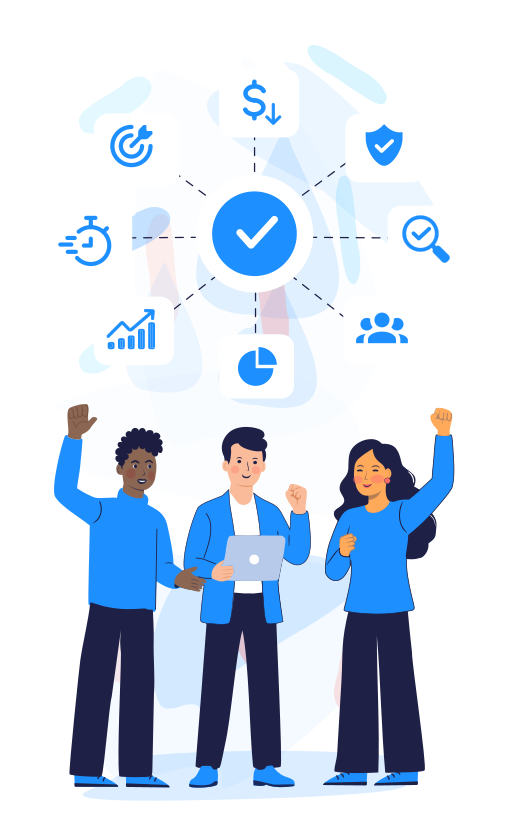
AI does a larger share of recurring operational work, and employees stop pushing it through the process by hand.
More cases, requests, transactions and work items can move through without the team growing at the same rate.
Defined workflows, knowledge, operating rules and decision boundaries are applied more consistently across repeated work.
Organizations can move from human-driven work toward operations that AI drives more and more independently, while people keep defined authority and control.
Agentic AI is AI that acts toward a goal instead of reacting to a prompt. An AI assistant performs the task it is asked for and stops. An AI agent receives a goal and the rules, plans the steps and uses tools and business systems. It keeps track of what has already happened and continues until the result is reached or a defined condition hands the case to a person. Agentic AI, strictly, is several such agents collaborating, each on part of the process. In business terms the difference is responsibility: the agent is accountable for the result, escalates what it can't handle, and a person supervises instead of directing every step. This is what lets execution scale beyond the number of people available to drive it.
Generative AI produces content on request: a draft, a summary, code, an image. The person decides what to do with it and what comes next. Agentic AI uses the same models but adds a goal, memory of the work in progress, actions in business systems and a control loop. It carries work forward rather than stopping at an output. A practical marker is connectivity. An assistant that can only talk is semi-useful; one connected to your systems can fill in the transfer form, update the record or schedule the delivery, and the person confirms. The economic difference follows from that. Generative AI makes each person faster at a task, while agentic execution changes how much of a process still needs a person at all.
An AI agent is one autonomous system that pursues a goal, makes decisions and acts within its rules. Agentic AI is the way of working in which several agents collaborate on a process: one produces the work, another verifies it against the quality criteria, others plan, delegate and report. The distinction matters in practice. A single agent, however capable in a demo, leaves the process human-driven if someone still has to trigger it, feed it and carry its result to the next step. Much of what is sold as an agent is an assistant that reacts to prompts. We build agents around a defined piece of business execution and build the workflow around them too, because the outcome depends on the whole chain rather than on one component.
In a business process, agentic execution looks like this. A request arrives through the channel people already use, chat or voice. The agent asks for the inputs and permissions it needs, then carries the work through its steps. It gathers information from the systems and people involved, hands specialized parts to other agents, checks the results against the defined criteria and delivers the completed outcome. The person sees the questions, the approvals, the exceptions and the final result. The same shape applies to a service delivered to a client, an internal request such as an invoice or a leave notice, a reporting cycle or a compliance check. The screens, buttons and intermediate documents that partial automation needed are replaced by the few decisions and control points that remain with people.
An agent needs three foundations and one proof. The process has to be defined, with its goal, roles, decisions, control points, artifacts and legitimate variations. The knowledge the process depends on has to be structured and current. The business systems it touches have to be reachable through connectors. Then the work has to be proven at the assisted and collaborative levels, main flow and edge cases, before an agent takes it over. This matters because in many companies these areas were left to people and handled informally, and AI can't work the informal way: whatever was never written down becomes a failure in production. AI Process Reengineering, AI Knowledge Base and AI Connectivity supply the three foundations, and this service supplies the agent.
People keep the control points the organization defines. Sensitive functions, such as moving money, changing a customer's terms or publishing to the outside world, need a named person's permission before they run. Sensitive results are reviewed by a defined person before they move on, and the person sets the direction and controls the result. Some of this control is automated as checks and balances, and some stays with people. The split is a design decision made before the agent is built. Defining it explicitly matters, because otherwise the agent either stops all the time or acts where it shouldn't. Even at full autonomy people aren't removed: they read the logs and are notified when the agent can't proceed.
We test it against explicit quality criteria, on real work. The ideal output is defined, and the criteria are written as checklists or as good and bad samples. The agent runs on representative cases: main flow, edge cases and failures. Each result is scored on a five-point scale tied to how much editing it would need, with a threshold set by the level of autonomy. Work that will run without a person must pass at the top score, because nobody is there to fix a near miss. The share of runs that pass is the quality score, and it must exceed the quality bar for the intended level before deployment. Because AI output is not deterministic, the tests are positive, negative and error cases judged against standards rather than fixed input-output pairs. They cover tool use, retrieval, guardrails and bias. An agent that fails the bar stays under human supervision.
We build them on the AI platforms our clients already use: OpenAI and ChatGPT, Anthropic Claude, Google Gemini, Microsoft Copilot, xAI Grok and open-source platforms. Each agent is packaged for the environment that fits the case, from Claude and Codex to Copilot and Gemini Gems. Where the platform allows it, we build with no-code and low-code tooling, and AI automation specialists rather than programmers can then maintain the agent. The agent's definition, from its goal to its checkpoints, is kept in a platform-independent brief. The business systems it works in are exposed through APIs and MCP servers that any agent can use. That's what keeps the choice open: when a better or cheaper platform appears, the agent is re-rendered for it instead of rebuilt.
You should get an agent that owns a defined piece of work, along with a written description of how it works. That description states the business outcome the agent is responsible for and the workflow with its completion conditions. It also lists the knowledge and systems the agent uses, the decisions it may take and the exceptions it hands to a person. Before go-live the agent is tested on real cases. It then runs under supervision, gets refined and is handed over with guidance for the people who supervise it. Without this definition an agent can perform a task while people still run the process around it. Our AI agent development starts from the outcome and the workflow. In multi-agent systems, each agent gets its responsibility defined the same way.
Yes, when the front desk is run as a workflow with clear rules. In a service business, requests come in by phone, text, email and booking platforms, and success means an appointment that stays booked. The agent checks that the address is in your service area, asks what the technician needs to know, offers open slots and books the visit. Requests outside the rules go to a person. A practical start is text-based requests, with phone calls staying with people for now. AI can also transcribe recorded calls and flag the ones the owner should hear. We build this kind of AI receptionist around your service rules and calendar and test it on real requests before it answers customers.
Show us where your people still start activities, direct AI, make routine decisions, move workflows forward and chase the work until it's done. We'll find where AI agents can take over responsibility for that execution.