
We automate proven workflows with AI assistants and agents, connect them to the systems and knowledge they need and check every critical output before autonomy expands.

A demo can handle the happy path. Real work brings missing information, changing rules, approvals, exceptions, system failures and outputs that have to meet a real quality standard.
Reliable automation starts with a process that already gives consistent results. Agents inherit the process, knowledge, quality criteria and escalation paths instead of making them up.
Agents are one part of AI workflow automation. Reliable operation also needs context, connections, verification, escalation and management visibility.
AI components that prepare, analyze, decide, route, draft, update or complete defined workflow tasks.
Independent checks against guidelines, checklists and good and bad examples before critical output moves on.
Secure access to business applications, data, documents and the approved context each task needs.
Clear conditions for approval, intervention, exception handling and final decisions.
Status, audit trail, output quality, failure reasons, AI cost and operational performance.
Access boundaries, security, monitoring, review rules and a controlled path for expanding automation.
Repeatable work runs without manual coordination. Every critical output is checked, every exception reaches a person who can decide, and automation widens from assisted to supervised execution without rebuilding what already runs.
AI Process Automation is for organizations with a workflow that is clear, repeated and valuable enough for AI automation. The workflow still needs the right controls, integrations, oversight and quality checks before AI takes on more of the work.
If the workflow is still unclear, start with AI Process Reengineering. If the knowledge is fragmented, start with AI Knowledge Base.
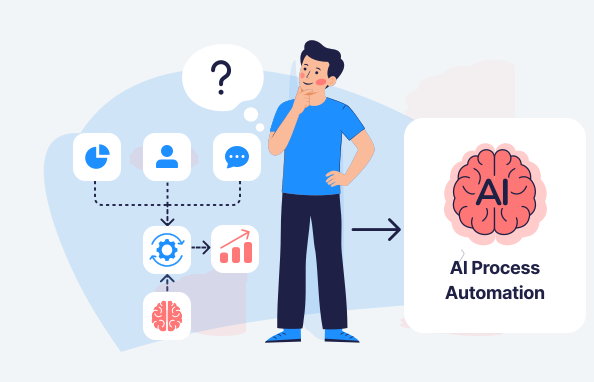
Without verification and visibility, teams keep people in every step, because the automation is too hard to trust.
With explicit quality criteria, independent checks and escalation, people supervise the workflow instead of carrying it by hand.
Each level expands only after the previous level produces consistent, reviewable results.
AI prepares, retrieves, drafts, classifies or analyzes while people run the process and validate the instructions.
Reusable skills and assistants complete defined parts of the work while people review, correct and sort out the exceptions.
Production agents run the workflow and escalate the cases they can't resolve, with context. People review the results and set the quality standards.
Verification agents check the work of production agents. Mature work runs inside explicit boundaries while people monitor performance, policy and exceptional decisions.
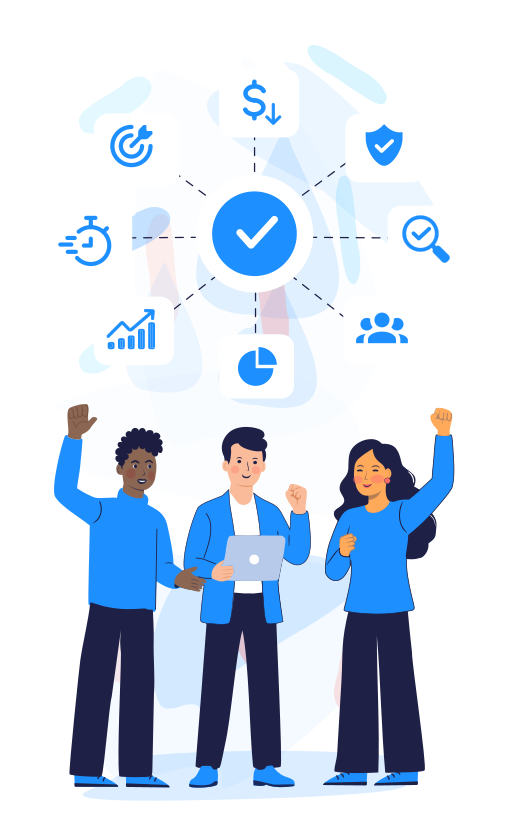
Fewer repeated manual steps, transfers, checks and corrections.
Cases move through connected systems with fewer delays and handoffs.
Output is checked against explicit criteria before it reaches the next step.
Professionals supervise results and handle judgment instead of repeating routine work.
AI automation, or AI for business operations, means running defined pieces of business work through AI, with the level of autonomy raised step by step. It ranges from skills and assistants that produce a work product on request to agents that carry a workflow to completion. It is built on three foundations: a defined process, structured company knowledge and connectors to the systems where the work happens. The common misconception is that AI either does a task entirely on its own or is useless. In practice, automation is a spectrum, and most of the value sits in the middle levels. We raise the level only where the previous one already gives a consistent result, under human supervision until the controls can take over.
AI workflow automation links the steps of a process into one chain in which some steps are performed by AI. A request or a concept comes in, each step produces its artifact from the previous ones, the result goes out and the operational follow-up runs. In such a workflow, AI handles the steps that need interpretation, system interfaces handle the mechanical ones, verification checks the critical outputs and exceptions escalate. We build it around a few tightly related processes in one problem area rather than one task. The value of automation appears when work moves between steps without a person carrying it, and the knowledge, connectors and controls of neighboring processes overlap.
Both, in different places. Rule-based automation, RPA included, is deterministic: the same input gives the same output. That's right for stable, structured steps and for driving a user interface that has no API. AI is probabilistic and goal-driven, which is right for variable inputs, unstructured documents and decisions that follow rules but need interpretation. A working automation combines them, and the market calls that combination intelligent automation. In one of our current projects, a legacy system is driven through its web interface while an API and an MCP server built on top let the AI read its data and act. Choosing one against the other leaves part of the process with people either way. Combining them is what covers the whole process.
It includes three things. The first is the automation itself: the assistants and agents, the connections to your systems and knowledge and the verification of critical outputs. It also covers the approval and escalation rules and the visibility of status, quality, failures and AI cost. The second is training for your team, because handing over an automation isn't enough: people have to use it, supervise it and know where their judgment remains. The third is ongoing support and improvement, because processes, systems and AI platforms keep changing. We include adoption deliberately. An automation that is delivered but not adopted changes nothing, and the team that runs the process is the one that will extend it.
Start with one that is already clear, repeated and valuable, where a consistent result is produced today and the effort, money or errors are concentrated. Readiness counts as much as value: the process described, the knowledge available, the systems reachable and the quality criteria known. An unclear workflow goes to AI Process Reengineering first, and fragmented knowledge to AI Knowledge Base. We choose this way because the first automation sets the pattern, the controls and the team's confidence for the next ones. Automating work that isn't consistent yet produces an inconsistent automation.
Sometimes, and the process decides, not the platform. Workflow engines, agent runtimes, RPA and low-code tools are useful for triggers, scheduling and mechanical steps, and we use whichever fits your environment, on the AI platform of your choice. Your existing business applications are connected, not replaced. What the platform can't supply is the definition: the process, the knowledge, the decision rules and the quality criteria. They are the lasting part of the automation and stay independent of the tool. Keeping them separate matters because platform costs and capabilities change quickly. With the definitions in hand, changing the platform is an implementation step rather than a new project.
Predictable failures are corrected or retried automatically first, with the review report attached. What remains escalates to the person responsible, with the context needed to decide: what came in, what was done, which check failed and what decision is needed. Approvals of sensitive results are built in. The workflow continues once the person decides instead of falling back to manual handling, and every outcome is logged. Exception design matters because exceptions are where automation usually collapses back into manual coordination. The failure log is also where the process improves: criteria that fail repeatedly point to instructions or knowledge that need fixing.
We measure it against four results: cost, speed, quality and capacity. Before automation we take the baseline: how long tasks take by type and complexity, what each case costs in effort, how often results need rework and how much work the team can carry. After it, the automation's own management view shows throughput, output quality against the criteria, failure reasons and AI cost, and the same measures are read continuously instead of estimated. We expect gains by multiples rather than percentages where a process moves from partial to full automation, and the same measures decide when a workflow is ready for the next level of autonomy. The yardstick is delivered results, not activity.
Ask four questions before you sign. Does the work start from your process or from their tool? How is every critical output checked before anyone relies on it? What happens when the AI isn't sure of an answer or a case falls outside the rules? Who trains your team and supports the automation after go-live? Clear answers to all four separate an automation that carries real work from one that stays a pilot. Here are ours. We start from a process that already works, check critical outputs against written quality criteria and route unclear cases to a person. We stay independent of any vendor, and autonomy grows one stage at a time, only after the outputs keep meeting the criteria.
Bring us a process that is clear, repeated and worth improving. We'll talk through the right automation level, the systems and knowledge it needs and the controls required for production use.