
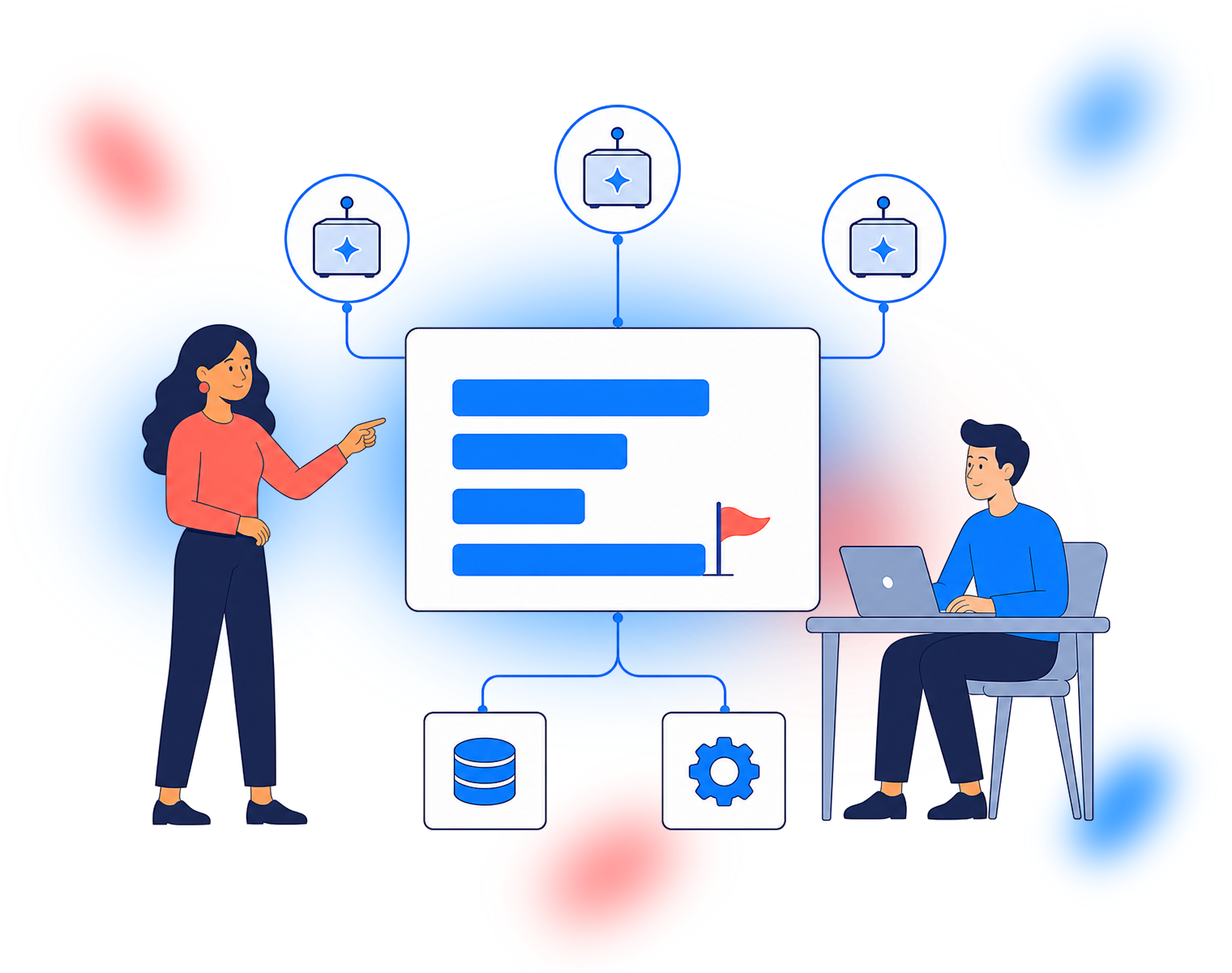
We build AI orchestrators that coordinate goals, multiple agents, systems and people. Execution stays visible, under control and moving forward.
As agents, systems, workflows and parallel activities multiply, the business can spend more of its time coordinating AI-enabled work and less of it benefiting from faster execution.
Instead of asking people to coordinate a growing collection of agents and automations, add an orchestration layer that manages the complexity. Users deal with the system in terms of goals, requests, information and decisions, and the orchestrator manages the execution underneath.
We build orchestrators around the way your organization actually works, whatever agent framework, model or platform sits underneath. The orchestrator becomes the layer that connects business goals with the resources that can carry them out.
Higher-level goals become coordinated plans and executable work. The orchestrator can structure initiatives, break goals into work packages, manage priorities and dependencies and keep execution on course for the intended outcome. It works for a single initiative or for broader portfolios of concurrent work.
This is AI project management across multiple projects, initiatives, shared resources, milestones, dependencies and changes. You can see what is active, completed, delayed, blocked or held up by a decision.
This is AI agent orchestration in practice. Each piece of work is routed to the right AI agent, workflow, system or person, based on the task and the operating context. The orchestrator manages handoffs, collects results, triggers dependent work and keeps execution moving across multiple resources.
It gives users a simple interface to a complex AI-enabled operating environment. Employees, customers, partners and other participants can give information, request work, get updates and approve decisions through familiar channels: email, messaging, web, chat, voice and other supported interfaces. Nobody has to operate the AI architecture. People ask for an outcome, answer questions and approve decisions, and the orchestrator works out what happens behind the scenes.
We define what information each resource can access and which actions it may take. Permissions, action limits, approvals, guardrails, escalation and human authority are built into coordinated execution. Because an orchestrator touches more systems than a single assistant and steers actions with bigger consequences, the control layer also covers access boundaries, approval requirements, human decision rights and exception handling. The aim is controlled execution at a larger scale, with autonomy kept within those limits.
The orchestrated system keeps a shared state. It tracks active work, open dependencies, completed actions, requested decisions, exceptions and overall progress, and nobody has to piece the status together from individual agents and tools.
We package the orchestration for the AI environments that suit the use case. The business coordination model stays stable as models, platforms, agents and the technology underneath change.
The orchestrator doesn't have to perform every specialized activity itself. Its job is to know the plan: who does each part, what follows, what is allowed, what counts as done and where people come in.
You get a coordinated execution model with defined planning, delegation and escalation logic, and a practical interaction experience for employees, customers and partners. Control and security are built in, and the orchestrator is integrated with the agents, systems and knowledge sources your operating model already depends on.
It's for organizations where outcomes already depend on multiple agents, systems, workflows, teams or external participants, while people still hold the execution together. The aim is an orchestration layer that coordinates AI-powered operations as they grow more complex.
If agents don't run your workflows yet, start with AI Agentic Execution.
A specialized agent is built for a particular type of work. Each agent solves its own problem. Someone still has to decide when to use it, give it context, sequence its work, manage dependencies, collect results, handle failures, report status and bring people in. The organization gains more AI capabilities, and more moving parts with them.
An orchestrator is built to manage execution across many kinds of work and many kinds of resources, and the complexity itself gets managed. It coordinates specialized capabilities around larger goals. It knows which resources are available, how the work should progress, what information is needed, which dependencies matter, where controls apply and when execution needs a person. A collection of AI capabilities becomes a coherent multi-agent system.
Understand the goals and the operating environment the orchestrator has to manage. Define the processes, users, agents, systems, expertise, knowledge, resources, permissions, dependencies, decisions and human responsibilities involved. Set what the orchestrator coordinates and where its authority ends.
Design how coordinated execution works: the logic for planning, decomposition, delegation, sequencing, communication, dependency management, monitoring, validation, escalation, security, permissions and human interaction. Design the user experience separately from the complexity underneath.
Connect the agents, systems, knowledge sources, communication channels and people the work needs. Test representative goals, execution paths, exceptions, permissions, handoffs, decisions, failures and expected results, and check that the system keeps work moving with visibility and control.
Package the orchestrator for the environment where it is used and deploy it into the right AI platforms, business systems, communication channels, interfaces and infrastructure. The architecture follows your operating model and doesn't depend on a single AI vendor.
Planning, assignment, follow-up, handoffs, status collection, dependency tracking and reporting move from people into the orchestration system.
More initiatives, customer work, operational processes and complex activities can move forward without coordination effort rising in step.
There are fewer delays between a goal and its planning, delegation, execution, validation, decisions, follow-up and replanning.
AI-driven execution grows while access boundaries, permissions, approvals, escalation, visibility and human authority stay in place.
AI orchestration is a layer that turns a business goal into coordinated execution across AI agents, business systems and people. Orchestrating agents don't do the work themselves. Their job is to plan it, delegate it to the right agent or person, check the results and report. The need appears as automation grows. Once a company runs dozens of skills and agents, someone has to assign work, supply context, connect outputs, track dependencies and follow progress, and that management effort becomes an expensive part of execution. Orchestration moves that effort into the system. The business can then run more initiatives in parallel without management growing at the same rate.
Workflow automation makes a defined piece of work run through AI: an assistant, an agent or a workflow for one part of the process, under human supervision. Workflow orchestration organizes many such pieces, and the people around them, into one whole working toward a larger goal. It sequences, allocates, tracks dependencies and replans when priorities change. We treat them as separate services for two reasons. Automation already contains a lot (connectors, assistants, agents and controls), and the second problem only appears after the first is solved. The difference shows in results: automation makes individual activities faster, and orchestration turns those separate gains into faster complete projects and more work in parallel.
You need multiple agents when one piece of work needs several specialties, or when the work has to be checked independently. The first multi-agent pattern in practice is a production agent paired with a verification agent that checks its results against the quality criteria. That pairing is what allows work to run without a person. The next is a coordinator per area, which plans, tracks and delegates for a group of agents and people, along with client-facing assistants that hand work inward. The goal of a multi-agent system is capacity: more initiatives moving in parallel with the same management structure. Several agents without orchestration multiply the coordination problem. That's why agents are added where the work requires them, and the orchestration layer manages them.
No. A working agent performs a type of work: it drafts, analyzes, processes a case. An orchestrator does none of that. It knows what has to happen, which agent or person should do it, what comes next, what is allowed, what is finished and when a person has to be involved. It is also the human face of the system, the one place where people set goals, answer questions and make decisions. The distinction matters because treating orchestration as one more agent in a chain gives you a brittle sequence of prompts instead of managed execution. The orchestrator is engineered separately, with its own planning, delegation, validation, permissions and reporting logic.
People use the channels they already have. Inside the company they talk to the orchestrator in the corporate messenger, for example Google Chat. Clients and partners reach the external assistants through email, WhatsApp, Telegram or a web chat, by text or voice. They state a goal, answer the questions the system asks, provide information and approve decisions. Everyday requests, such as sending an invoice or giving notice of leave, go to the same assistant. Nobody operates the agents underneath or moves context between tools. This matters for adoption: a complex system gets used when its entry point is as simple as a message, and ignored when people have to understand every workflow behind it.
They are part of the orchestration logic from the start. Each agent, system and person has defined information access and allowed actions. Sensitive functions need a named person's permission, consequential decisions escalate to the person who holds the authority, and handing a result to a client is itself a control point. The system's behavior under these rules is tested automatically, and the shared execution state shows what is active, blocked, completed or waiting for a decision. The control layer matters more here than anywhere else, because an orchestrator reaches more systems and coordinates more consequential actions than a single assistant.
Each agent, assistant and workflow solves its own task and leaves the connecting work to people. Someone has to pick the moment to use it, supply the context, sequence it with the others, collect the result, handle what failed, report status and bring in the right person. As the number of capabilities grows into dozens, this invisible work grows with it, and the company can only scale as fast as the people doing it. We saw this in our own operations. Coordinators were first useful for helping people plan and track, and as agents multiplied, they began handing work to the agents directly and checking the results. Orchestration is that coordination moved into the system.
Orchestration is the right next step when several agents, systems, workflows or teams already contribute to one outcome and people are holding them together. They translate goals into tasks, assign work, chase status and move context between tools. It is not the first step. While a person works one-on-one with an assistant, no coordinator is needed. In our own company, the orchestration layer was added last, after the automated areas had reached the collaborative level and the number of agents had started to grow. Orchestration applies inside the company, to programs, projects and cross-functional work, and outside it, to customer support, service delivery and partner coordination.
Show us where people still coordinate agents, systems, projects, handoffs, decisions, customers, partners and follow-up by hand. We'll find where a purpose-built orchestration layer can simplify the experience, cut coordination effort and connect fragmented execution, so your AI capabilities work as a coherent system.