
We build AI guardrails, quality checks, automatic correction, human-in-the-loop approvals and escalation into execution. Routine work then runs with less manual supervision.
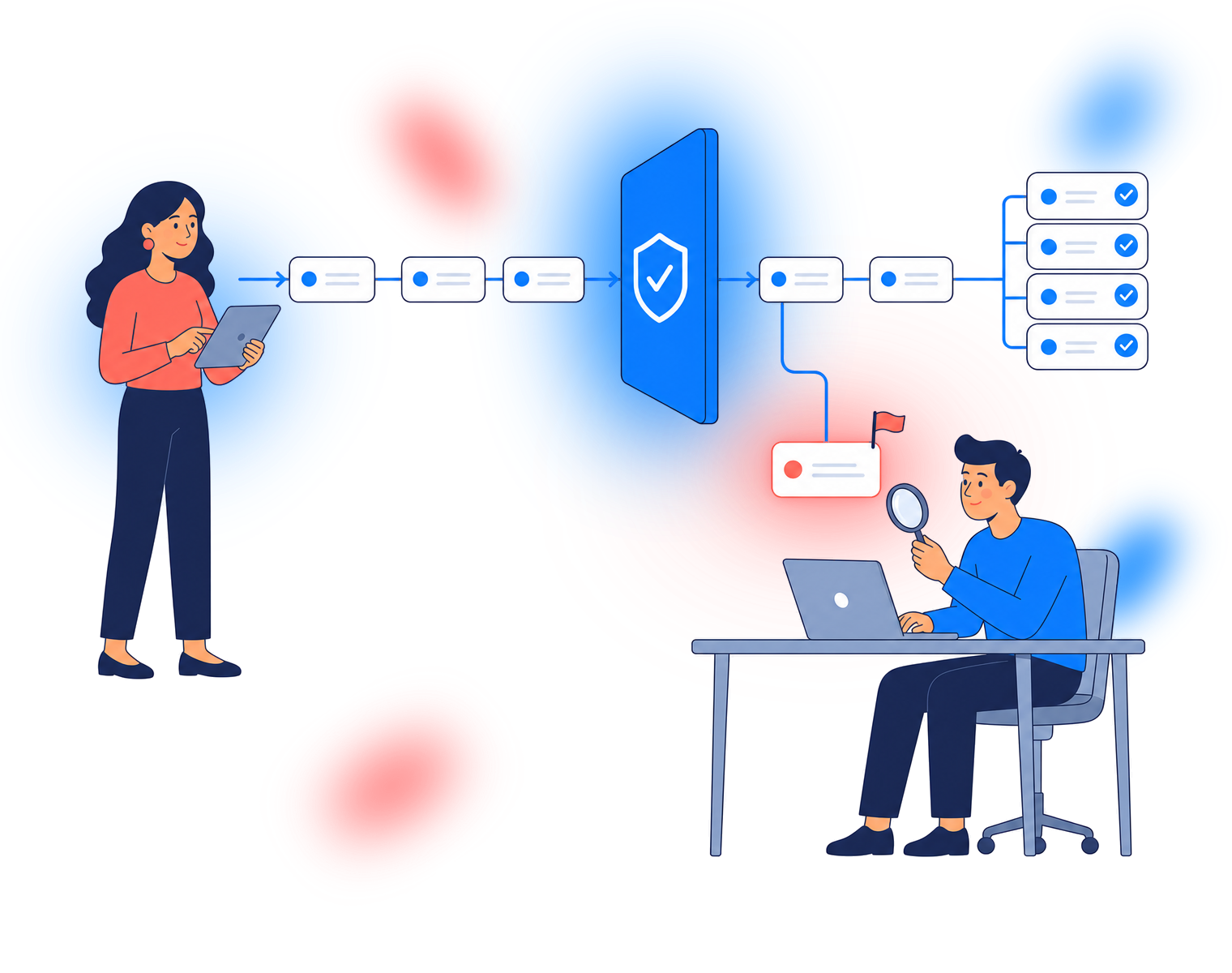
As AI takes on more work, the economic advantage shrinks if employees still have to inspect routine outputs, approve routine actions and fix predictable failures.
Validation checks whether an AI result meets the required quality bar. Control checks whether an action is allowed, whether its conditions hold and whether the execution produced an acceptable result. Routine cases go on automatically. People step in when judgment, authority, uncertainty or real business consequences call for them.
We turn business expectations, quality requirements and operating rules into mechanisms that can be tested, measured and enforced while AI does the work.
We define explicit acceptance criteria, thresholds and, where useful, representative good and bad examples. Each validation gate is tested against known correct and incorrect cases, and its performance is measured before it governs live execution.
These are hard guardrails: which actions AI may take and under what conditions. Pre-conditions protect a sensitive action before it runs, and post-conditions check that the resulting state is acceptable before the work continues. Consequential actions still need a named person's approval, which keeps a human in the loop where it counts.
Routine failures go into defined correction or retry loops instead of landing on an employee's desk. Stop conditions end the attempts when automated recovery no longer makes sense.
Uncertain, sensitive or consequential cases go to the right person, with everything they need to make the call. Human authority stays where it matters, and people are no longer responsible for every routine case.
AI carries more work forward on its own, and people keep their attention on the decisions, exceptions and situations that really need it.
It's for organizations where AI already produces important outputs or performs business actions, but people still do most of the validation and oversight. The aim is to move routine quality checks, controls, correction and escalation into the execution system itself.
If AI does not yet do the work, start with AI Agentic Execution.
Many AI implementations become more autonomous by gradually removing human review. The execution underneath hasn't necessarily become more reliable. The organization has simply accepted more uncertainty.
We build AI governance into the execution itself, with validation and control running inside the work. AI earns a larger operating scope when outputs keep meeting measurable requirements, actions stay within defined limits and failures are handled predictably. That gives a practical path to more AI autonomy without giving up visibility, safeguards or human authority.
Define what an acceptable result looks like, which actions need protection and where human authority must stay. Set explicit criteria, thresholds, operating rules and, where useful, representative cases.
Build the validation gates, action controls and execution checks. Test them against known correct, incorrect and edge cases until they reach the required level of performance.
Define what happens when a check fails. Routine problems can be corrected or retried automatically, and the uncertain, sensitive or consequential ones are escalated to a person who can decide.

Routine quality checks and execution verification move from employees into the automated control layer.
Problems are caught before a bad output or action creates more work and rework downstream.
AI can take on more work without supervision having to grow at the same rate.
Sensitive actions stay subject to defined conditions, verification and human escalation where automated handling isn't enough, and the actions are logged for your compliance owners.
AI governance is the set of rules, responsibilities and controls that decide what AI may do in the business and who approves what. It also covers how quality and risk are measured, how failures are handled and what records are kept. It starts with an inventory of the AI people already use, shadow AI included. In operations, governance has to be part of the system's design rather than a policy next to it. The control points, the permissions on sensitive functions, the validation of results and the escalation paths are built into execution. It matters because exposure grows with authority: an AI that writes drafts can be wrong cheaply, and an AI that takes actions in your systems can't. Our working rule is that AI does the execution and people control it, with as much of that control as possible automated as checks and balances and the rest kept as human supervision.
AI guardrails come in two kinds. Hard barriers block what must not happen: permission gating and access limits, pre-conditions that must hold before a sensitive action runs and post-conditions that verify the result. Filtering and masking of data that must not pass, stop conditions and escalation belong here too. Soft guides shape behavior toward the right outcome: role and goal instructions, system-level context, quality standards written as checklists or as good and bad samples, and re-ranking of outputs by their fit to the standard. Both are needed, because barriers alone keep AI inside the lines but don't help it reach the destination. In our work, guardrails are tested like any other part of the system, including for bias, and their performance is measured before they govern live execution.
Human in the loop means a person validates each result or approves each action before the work continues. In our levels this is approval, the second level. Human on the loop means AI executes and the person monitors, intervenes and restarts when needed, receiving only what the controls flag. This is supervised execution, the third level. Beyond it, in unsupervised operation, a production agent does the work and a verification agent checks it against the quality criteria, while people read the logs and handle notifications. The distinction matters economically. Review in the loop grows with the volume of AI execution, which eats the savings as automation scales. Moving routine work on the loop is what restores them, while consequential actions, such as moving money, keep a named approver in the loop by design.
AI hallucinations are confident outputs that are wrong: invented facts, values, references or steps. In business processes they have a specific cause. Part of the context is missing, the model fills the gap, and because output is probabilistic the invention changes from run to run. That's why they are controlled at the level of the process rather than the model. The knowledge the process needs is made complete and current, and the instructions carry explicit patterns instead of leaving the AI to improvise. Critical results are checked against the quality criteria before they move on, and uncertain cases escalate. For work that runs without a person, a verification agent checks every result, because a hallucination inside an automated process is an action, not a draft.
AI evaluation means measuring AI output and the controls around it against explicit standards instead of impressions. Here is the method. Define what an ideal result looks like. Score each output on a five-point scale tied to how much editing it needs, from perfect to unusable. Set the threshold by the use case, accepting only perfect results where no person will review. Then track the share of outputs that pass, which is the quality score. That score is compared with the quality bar for the intended level of autonomy, which rises as the AI takes on more steps, because evaluation and correction get more expensive. The criteria can start with a person accepting and rejecting results and then be automated from that history. Controls are tested the same way, with positive, negative and error cases, before they govern live execution and continuously afterwards.
We don't certify against frameworks, and we don't give legal or compliance advice. What we build is the operational side of AI risk management and AI compliance that such frameworks ask for. That means defined quality criteria, controlled and logged actions, permissions on sensitive functions, human oversight at defined points, documented escalation and records of what the AI did and why. These mechanisms give your compliance owners evidence that AI is governed in practice rather than on paper. Which obligations apply to you is for your compliance function or advisors to decide, and we work with them to make the controls match those obligations.
Yes, when the failure is predictable. A result that misses a known criterion, a missing field or a formatting error goes back into a correction or retry loop with the review report attached, and a stop condition prevents endless attempts. The failure log shows which criteria fail repeatedly, and that is where the instructions or the knowledge get improved. Only what remains uncertain after correction, touches a sensitive action or carries real consequence reaches a person, with the information needed to decide. This matters because predictable failures are the bulk of what reviewers handle today. Automating their correction is where review effort actually drops, and the human corrections that remain become the material for the next automated criteria.
When the control is automated, it does the opposite. The slow version of control is a person inspecting routine results, approving routine actions and fixing predictable failures. That work grows with the volume of AI execution and becomes the new bottleneck. Validation gates and action checks run inside execution, in the time the AI already takes, and send people only the exceptions. The result is more AI execution from the same review capacity, and failures caught before they spread into downstream rework. There is also a quality argument: an agent launched without control produces poor work faster, and the correction afterwards costs more than the check would have.
AI governance consulting turns your business expectations into controls that work while AI is running. That means quality criteria for outputs, automated evaluation, limits on sensitive actions, automatic correction of routine failures and escalation to a person when the AI is unsure or outside its limits. A policy document on its own doesn't stop a wrong output in a live process. We build these controls into the workflow and measure them. AI gets a wider scope only when its outputs keep meeting the requirements. A good AI governance consultant leaves you with controls you can test and numbers you can watch, along with the rules.
Show us where people still inspect AI outputs, approve routine actions or fix repeatable failures. We'll find where validation and control can move routine oversight into the system, while human judgment and authority stay where they matter.