
Generic models know the market. They don't know the rules, decisions, examples and exceptions that make your business work. We turn that knowledge into a governed AI knowledge base your AI systems can rely on.

What a language model already knows hasn't been checked against your company. When current rules are scattered across documents, systems, code, chats and experts, AI sees an incomplete version of the business and fills in the rest with assumptions.
Reliable AI needs more than access to documents. It needs a knowledge model, verified sources, clear owners and the right delivery method for each type of knowledge, such as retrieval-augmented generation (RAG) or a knowledge graph.
We organize what the business knows, fill in what is missing and define how AI should reach each type of knowledge.
The domains, areas, assets, entities, rules and relationships that describe the business consistently.
The documents, systems, databases, codebases and experts that hold the current evidence behind that model.
Structured interviews, reverse engineering and focused documentation to capture knowledge that doesn't exist in a usable form yet.
Retrieval for knowledge that changes often. Reusable knowledge files or fine-tuned models where knowledge is stable and used constantly.
Tests for completeness, accuracy, conflict, traceability, freshness and correct use in AI output.
Named owners, review events, update rules, permissions and maintenance responsibilities.
Expertise that lived with individuals becomes shared and available. Answers stop depending on who asked or how the question was worded. Every later initiative starts from a foundation that already exists instead of building its own.
AI Knowledge Base fits organizations whose assistants, workflows or agents need consistent company-specific context, while the knowledge they need is scattered, undocumented, conflicting or unowned.
If the process itself is still unclear, start with AI Process Reengineering.
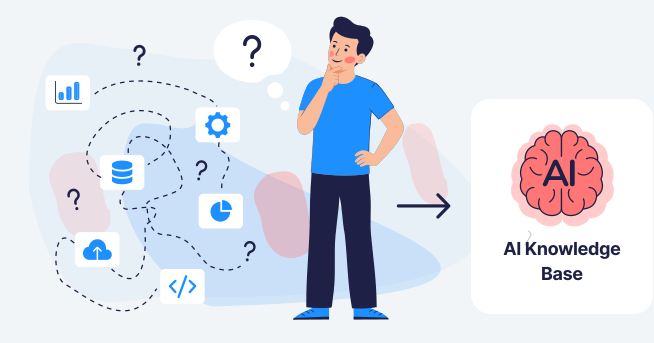
Without a shared knowledge foundation, every AI project repeats the same discovery, prompt design, source cleanup and expert review.
With the foundation in place, the business can give the same reliable context to its assistants, workflows, agents and future platforms.
We start from what AI has to know to do the work, not from loading every document we can find into a retrieval tool.
Define what the target workflows need to know, organized into domains, areas, assets and entities, with their rules and relationships.
Connect the existing evidence, resolve conflicts, find the gaps and capture missing expertise through structured interviews or reverse engineering.
Choose how each type of knowledge reaches AI, from RAG implementation to knowledge files and fine-tuning. Test how AI uses it in its output, assign owners and set the update and review rules.
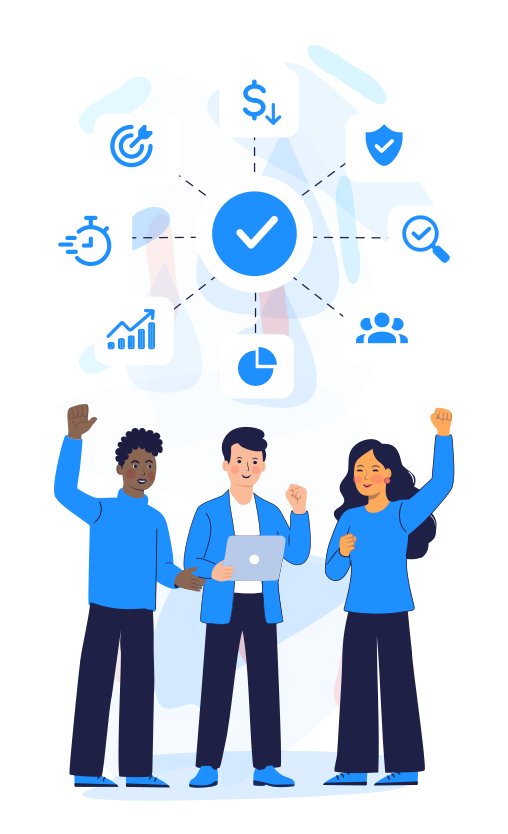
New assistants and workflows start from a knowledge foundation that already exists.
AI works from the same verified business context across teams and tools.
Recurring expertise is captured, and specialists get their time back for exceptions and improvement.
Business knowledge moves between models and platforms without being rebuilt from scratch.
An AI knowledge base is structured, governed company knowledge that AI assistants and agents use when they do their work: rules, procedures, decisions, examples, exceptions and reference data. A process says how the work is done. The knowledge base says what the business knows, and that part is usually missing: it lives in people's heads, and in documents it is stale or absent. We build it as a model rather than a pile of files. It has knowledge domains and areas, the containers and documents where each piece lives, the entities inside them, a map of sources, the gaps and a named owner for each area. It matters because a language model's built-in knowledge of your domain is unverified tokens and weights. What it returns is a guess until the domain is formalized. After that, you can rely on it.
Retrieval-augmented generation (RAG) is a method in which the AI model looks up relevant content in your own sources at the moment of a request. It answers from that content instead of from training memory, which makes answers specific to your business and traceable to a source. We use it for dynamic knowledge, the part that changes daily. Retrieval can find a document. It can't judge whether the document is current, whether a conflicting rule exists elsewhere or whether the important knowledge was ever written down. Without proper context, AI doesn't work: it fills the gap and gives a different, sometimes opposite, answer tomorrow in the same situation. That's why the knowledge model and the source map come first, and retrieval is connected to verified, owned sources.
The answer is both, decided per type of knowledge. We split what the business knows into dynamic knowledge, which changes day to day and is connected through retrieval, and static knowledge, which changes rarely. Static knowledge ships either as knowledge files inside projects and workspaces or inside a fine-tuned model. LLM fine-tuning has an economic reason as well as a quality one. Large generic models are priced by the token, and the cost rises with use. For a domain you query constantly, a smaller, cheaper model with your static knowledge baked in, run on your own servers, can be the economical choice. Regulated businesses already run self-hosted open models this way. A well-worked process doesn't need the most powerful model.
A knowledge graph stores business entities and the relationships between them explicitly. AI can then follow connections instead of relying on text similarity alone. In our knowledge model, the same ground is covered by organizing knowledge into domains, areas, containers and entities, with classification, relationships, metadata and rules. A graph is one way to deliver that structure. It's useful when answers depend on combinations, for example which rule applies to which product for which customer type. We build one where the structure of the business requires it. For many businesses, a well-organized knowledge base with clear relationships and owners is enough. The knowledge graph is part of this service.
Enterprise search, like a classic knowledge management system, returns documents for a person to read and interpret. A knowledge base gives AI the verified context it needs to act: the current rule, the acceptance criteria, the approved example, the exception. Connecting every wiki, mailbox and ticket system to an AI tool solves access, which is a precondition. But access to stale and conflicting material produces confident answers from the wrong version. The knowledge base adds what search lacks: a model of what AI needs to know, a map of where it lives, the gaps filled and ownership with review and update rules. The difference shows in practice: instead of a search box, a company gets its SharePoint reorganized and connected to AI, and its assistants can rely on it.
We capture it through structured interviews and reverse engineering. For knowledge that lives in people, we build an interview plan and run the interview by chat or voice, often with an AI interviewer. The transcript is turned into documents and verified by the person who owns that knowledge. For knowledge that lives in systems and code, we reverse-engineer the architecture and recover the business requirements from it. Filling the gap is less heavy than it sounds once the knowledge model shows exactly what is missing. It matters because the knowledge that was never written down is usually what makes the business work, and it is exactly what AI can't infer.
Because part of the key context is lost, AI invents the missing part. When AI reproduces a process with a piece of the information missing, the model hallucinates to fill the gap. Today it generates one thing, tomorrow something different or even the opposite in the same context. Connecting more documents doesn't restore the missing piece. Often the material is in such a state, folder structure and file names included, that it's hard to tell where anything is and who is responsible for it. What exists is stale because nobody maintained it. The yardstick we use is consistency and repeatability. It's reached by restructuring the knowledge, filling the gaps and assigning owners rather than by better search.
Your organization does, with the structure set up during the work: a named owner for each knowledge area, review cycles, update rules and quality checks for completeness, accuracy, conflicts and freshness. We assign ownership during the engagement rather than after it, because unmaintained knowledge decays very quickly. Every assistant and agent built on it decays with it. The staleness we see in companies' documents has exactly this cause: nobody was responsible. If you prefer, we keep maintaining the knowledge layer under an ongoing support arrangement as processes, systems and AI platforms change.
A RAG implementation lets AI answer from your company's sources instead of from general training data. The pipeline is only part of it. A working one depends on decisions about which source is authoritative, which version is current, who owns each topic and how answers are checked. Without them, retrieval pulls similar text from outdated or conflicting files and the answers stay wrong. We build enterprise RAG as part of an AI knowledge base. The knowledge is modeled and governed first, then connected for retrieval, with a knowledge graph where the relationships between facts matter.
Find out what knowledge a priority workflow depends on, where it lives, what is missing and how it should be governed before AI relies on it.