
We build MCP servers and other integrations that give AI direct access to the data and actions it needs across legacy, custom and modern business systems.
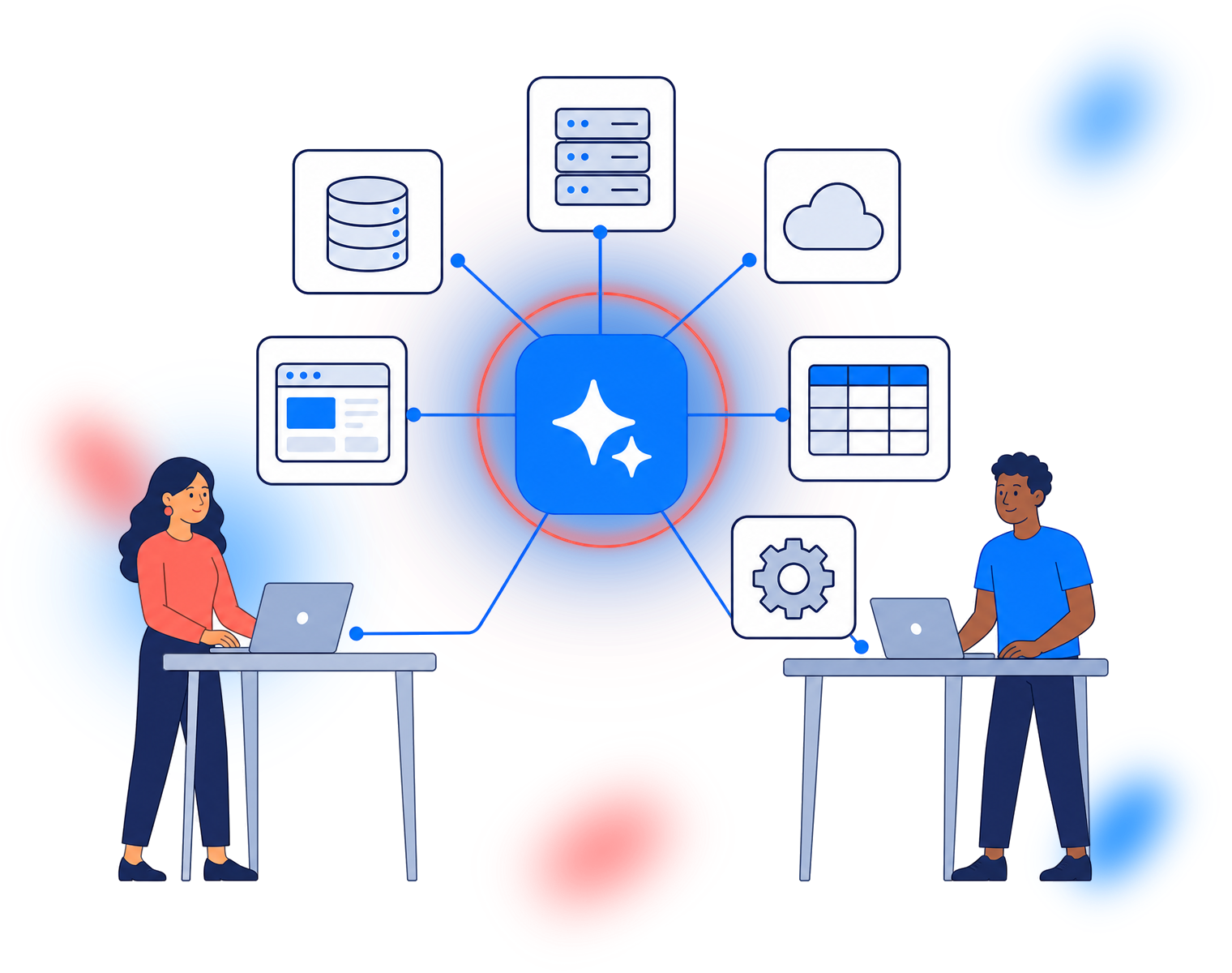
AI can do meaningful work, but it keeps stopping when information or actions have to pass through business systems AI can't use directly.

AI Connectivity is AI integration built around the business process: AI gets direct, purpose-built access to the information and system actions the process requires. Employees stop moving work between AI and business applications, because AI works in those systems as part of the execution itself.
We engineer the access AI needs to work across your technology environment. That can include MCP servers, custom connectors, purpose-built interfaces, direct system access, adapters, APIs, database integrations, file and storage access, web interactions and other mechanisms that suit the environment. The aim is to make the business information and actions the work requires directly usable by AI.
AI gets the operational information its work requires, such as structured system data, database records, files, stored documents, application state or information from existing services and interfaces. Employees no longer have to find it and pass it along by hand.
AI can take the actions that move the work forward. Depending on the process and the authority model, that can mean retrieving, creating, updating, triggering, submitting or completing operations inside business systems. Instead of recommending the next action, AI takes part in the execution.
We design connectivity around the interaction the business process actually requires. Instead of exposing everything a system can do technically, we pin down the information and actions the AI needs and build the connection around them. That can cut unnecessary calls, transformations, intermediate processing and complexity.
Existing technology shouldn't block AI adoption by default. We engineer practical AI access for legacy, proprietary, in-house and specialized systems where standard integrations or modern APIs are incomplete or missing. AI automation can then reach further across the environment you already run.
Different systems need different approaches. Connectivity may use existing APIs, databases, files and storage, web applications, direct application integration or other access mechanisms. The system and the business requirement decide the implementation, not a preferred integration technology. We build in .NET, Java, Node.js, Python, Go or another technology that suits the environment, and the result can serve ChatGPT, Codex, Claude, Microsoft Copilot, custom agents, AI workflows or your own software applications.
The capability reaches AI through the interface that fits the target environment: MCP (Model Context Protocol), REST APIs, command line interfaces, embedded integrations or another suitable pattern. The same business system can then serve different AI environments, agents, workflows and software applications.
The engineering deliverable may be a purpose-built connector. The business outcome is broader: AI can reach the systems, information and actions it needs to do more of the process directly.
You get connectivity built around the information and actions your business process requires, exposed through MCP, REST, command line, embedded integration or another suitable interface. Modern, legacy and custom applications become usable by AI without being replaced just because they lack modern AI interfaces. The connectivity is verified through functional and non-functional testing before delivery.
Choose how you receive it. Your team can take the source code and own maintenance and extension, or get a ready-to-deploy package of binaries, executables or containers. We can also deploy and configure the connectivity in your environment or, where it fits, host and operate the connector as a managed service.
It's for organizations where AI can already do valuable work but legacy, custom or modern systems still create manual handoffs. The aim is to let AI reach what it needs for more complete end-to-end execution.
If AI doesn't do valuable work in the process yet, start with AI Execution Assistance.
Start with what the system exposes. The existing API or standard connector offers its predefined objects, endpoints and actions, and the AI workflow has to adapt to that interface. When the process needs something different, extra calls and transformations get added. The systems are technically connected, but the AI inherits much of their complexity.
Start with what the AI must do. We work out the business process, the information AI actually needs and the actions that keep the work going, and we design the interaction around them. The right capability goes through the right interface, with fewer calls, transformations, data movement and AI processing. The result is connectivity engineered for execution.
Understand the business process and what AI must read, update, trigger or complete in it. Assess the systems involved, their interfaces, the information and actions required, the technical constraints and the operating environment. Then define the interaction model between AI and the business system.
Design the connectivity around the interactions the process actually requires: which capabilities to expose, how AI reaches them, what information passes between the systems and which interface fits the execution best. Cut unnecessary calls, transformations, processing and complexity along the way.
Build the connectivity and interfaces, from MCP server development to custom adapters. Verify them with automated functional and non-functional tests against the intended AI interactions, the expected system behavior and the relevant execution scenarios.
Package or deploy the capability in the form that suits your environment, ready for the ownership and operating model you agreed on.
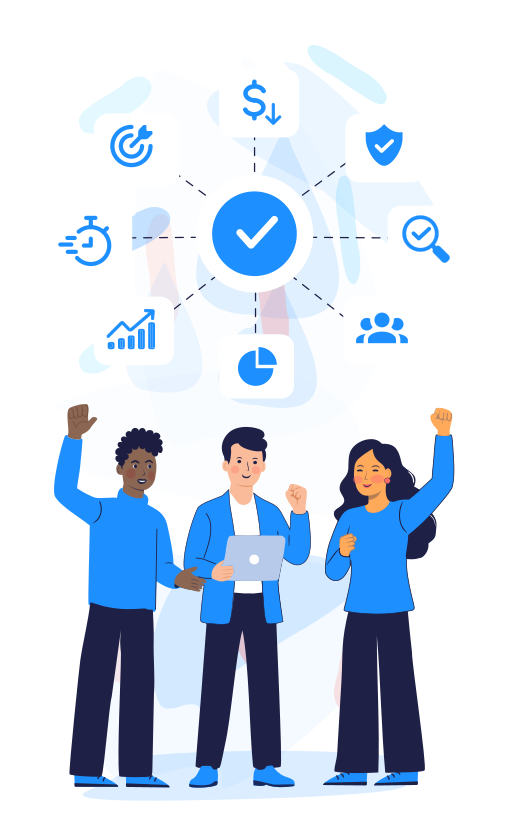
AI can carry on through business systems instead of handing routine system work back to employees.
People spend less time moving information and actions between AI and operational applications.
More efficient interactions can reduce unnecessary data movement, AI processing and token consumption.
Organizations can expand AI automation without replacing valuable applications just because they weren't designed for modern AI.
An MCP server is an interface that exposes a system's data and actions to AI assistants and agents through the Model Context Protocol. The protocol is an open standard that Anthropic introduced in 2024 and the major AI platforms support. The server describes its tools in a form the AI understands, for example "find customer" or "create ticket", and the AI calls them while it works. It matters because an AI that can't reach the systems is a tool, not automation. An assistant that can only talk stays semi-useful, while one that can read and act in your applications solves real tasks. We define connectivity from the business process: which systems it touches and what the automation must read or do in them. We use existing connectors where they exist and build them where they don't.
An API is the interface a system offers to other software. An MCP server is an AI-facing layer that presents a system's capabilities in a form an agent can use directly, usually on top of an API, a database or a user interface. The two differ in granularity and purpose. An API exposes what the system can do, while the connector we build exposes what the automation needs to do, as a small set of well-described tools with responses shaped for the AI's use. MCP is one interface option. REST, a command line interface or a platform plugin can play the same role, and the choice follows the AI environment and the system. The API, where one exists, usually stays underneath.
We build it from the process, not from the system. We identify the business interactions the automation requires and write a connector design brief around them. The connector is then implemented on your technology stack, with the interface that fits the AI environment. Automated tests check its functional and non-functional behavior, and it is packaged for your deployment model, managed by your team or hosted under an agreed arrangement. Starting from the process matters because a connector that mirrors the system's full interface is technically connected and still hard for an agent to use. You receive the brief, the tested connector and its documentation, and the source where the connector is custom code.
Yes. Where a system has no API, or an incomplete one, we build the access another way: over the web interface, through the database, through files and storage or by direct application integration. We expose only the information and actions the workflow needs. A current example is a legacy warehouse system that offers nothing but a web interface. We are building an API and an MCP server on top of it to let AI read its data and perform simple actions. The alternative, replacing an established system to make it accessible to AI, can turn adoption into a major IT program. Connecting a system never designed for integration does take engineering. It is still the shorter path when the system's functionality is sound and only its connectivity is missing.
They are three layers, and an automated process needs all three. Skills carry how the work is done: the instructions, the steps and the output. The knowledge base carries what the business knows: rules, procedures, examples. It is connected through retrieval for the part that changes and as static knowledge for the rest. Connectors, MCP among them, give AI access to where the work happens: the records, transactions and actions in your systems. Confusing them matters because each is sold as the complete answer. The result is a knowledge base that can't act or a connector with no process behind it. We build them in a fixed order: process, then knowledge, then connectors, and only then the skills, assistants and agents that use all three.
An interface designed for software, or for a person clicking through screens, isn't designed for an agent. Exposed in full, it hands the AI dozens of endpoints, large responses and the job of working out which calls to combine. Every unnecessary call costs time and processing and is another chance to go wrong. A connector built around the use case exposes the few interactions the workflow needs and returns information in the form the AI will use. That cuts unnecessary calls, excessive data retrieval and extra AI processing. This matters as automation scales, because an interaction an agent repeats thousands of times becomes an operating cost. The same system can still be reached by several AI environments through one such connector.
Security is designed in before the connector is built. The connector runs under the system's own authentication and permissions and exposes only the actions the workflow needs. The AI gets no more access than the account it uses. Sensitive functions are marked as control points: they need a named person's permission before they run, and sensitive results are reviewed before they move on. Where data must not reach a model at all, the workflow keeps it out. The connector is deployed where you decide, in your environment under your management or under an agreed hosted arrangement. Tests make sure an exposed agent can't be turned into a way into your data. We take the caution about giving AI access to working systems seriously. Narrow, reviewed access is what makes automation acceptable to IT and compliance.
You do. Everything built for you is handed over: the working connector, its source code where it is custom, the documentation and the workflow it supports. How it runs afterwards is your choice. Your team maintains and extends it, you receive a ready-to-deploy package, we deploy and configure it in your environment, or we host and operate it under an agreed arrangement. Connectivity outlives any single automation, because the same connector serves the next assistants, agents and orchestrators that need the system. That's why it is built and documented as a lasting asset rather than as part of one project.
AI integration services give AI access to the data and actions a business process needs. The work starts with the process: what the AI must read, which actions it takes and with which permissions. Then the interface gets built. It can be an MCP server, a custom connector or an API. A legacy system with no API is reached through its web interface, its database or its files. Exposing a system's full API hands its complexity to the AI and adds cost with every unnecessary call. We design each connection around the work, and you own what we build, including the source code of custom connectors.
Tell us what your AI needs to read, update, trigger or complete, and which business system stands in the way. We'll define the AI integration that makes that system part of the AI execution flow.