
We combine strategy, process redesign, knowledge engineering, system connectivity, automation, control and adoption into one end-to-end AI transformation path. The result is an AI agency: a company whose routine work is carried out by AI agents.

Tools, pilots and agents can multiply while the business still depends on manual coordination, scattered knowledge, disconnected systems and constant human correction. Cost and complexity go up, and the way the work gets done stays basically the same.

The transformation joins up the parts that AI consulting services usually treat as separate projects: strategy, processes, knowledge, systems, agents, verification, governance and team adoption.
Each component is useful on its own, and the transformation makes them work together as a system.
The target operating model, opportunity priorities, readiness decisions and phased roadmap.
Goal-oriented process definitions, information flow, responsibilities, variants, exceptions and execution assets.
Structured, verified, connected and owned business knowledge for people and AI.
Secure access to existing applications, data, documents, databases and legacy tools, including systems without standard APIs where feasible.
Assistants, production agents, verification agents, workflow logic, escalation, monitoring and management visibility.
Training, operating instructions and ownership for AI adoption, along with access boundaries, quality control, risk management and continuous improvement.
Systems that run the work replace manual coordination. The change comes step by step, and nothing in the business has to stop for it. The cost and speed advantage builds while competitors are still running isolated pilots.
AI Agency Transformation is for organizations that need AI to change how the business operates, beyond helping with individual tasks.
It's the right fit when AI spending keeps rising, pilots pile up, agents are on the agenda and leadership needs a structured path to measurable operational change.
If the organization is not ready for full transformation, the best first step is AI Organization Strategy.
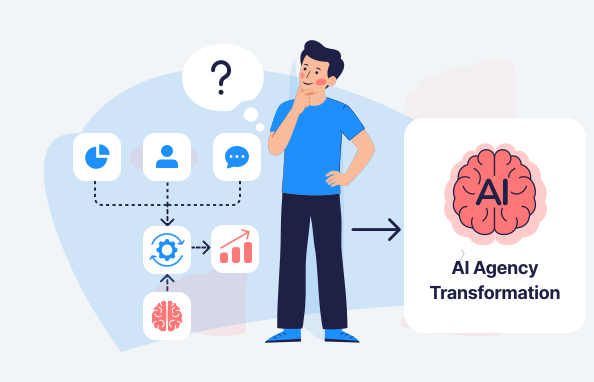
A layer of tools on top of the old operating model adds capability but leaves the cost, coordination and quality constraints in place.
A connected operating model lets AI carry more of the work, while people keep control over judgment, quality and change.
We work backward from the target state and run the AI implementation without throwing away operations that already work.
Set the AI-native target state and the business priorities, decide what has to be ready and lay out the phased roadmap.
Make goals, information flow, responsibilities, decisions, variants, exceptions and quality standards explicit.
Structure the business context AI needs and connect the applications the work runs through.
Start with assistance, prove consistent execution, then bring in agents, verification and broader workflow automation.
Run the system with monitoring, governance, escalation and human authority, and improve and expand it as the evidence supports.
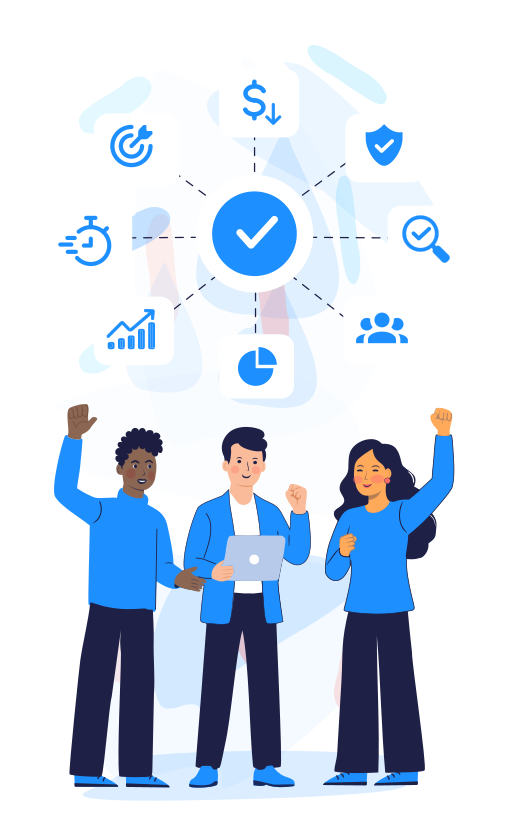
Less manual execution, repeated coordination, correction and duplicated AI investment.
Work and decisions move through connected processes with fewer delays.
Shared knowledge, explicit criteria, independent verification and visible control lift the quality of the work.
Professionals direct, supervise and improve execution while AI handles more routine work.
AI transformation is moving a business from operations run by people with tools to operations in which AI executes a large share of the work under defined control, department by department. It changes how the business runs instead of adding a set of tools to it. The target operating model, the processes, the company knowledge, the connections to systems, the assistants and agents, the controls and the way the team works change together, in a sequence that keeps the business running. It matters because traditional automation left large holes that people filled, and AI closes them for the first time. A business that completes that shift operates at a cost and speed that partial automation can't match.
An AI-native organization is one whose operations are designed to run through AI. Its processes are explicit, its knowledge is structured and owned, its systems are reachable by agents and its quality and risk controls run inside execution. People set direction, supervise, handle exceptions and improve the work. On its own the term says little. We define it by what it produces: more output from the same team, shorter cycles from decision to delivery, consistent quality and the ability to grow without growing staff at the same rate. The fully autonomous end state, an operation that runs with people only setting goals and handling rare exceptions, is still ahead of most companies. What is reachable now is a business that moves area by area in that direction, keeping what works along the way.
AI consulting firms usually cover one part of the problem: a strategy, a platform implementation, an integration or a set of agents. The client coordinates the rest. We do the whole path in one team: strategy, formalization of processes and knowledge, connectivity, automation, implementation and training of your people. For companies the size of our clients, that matters directly, because finding several vendors and handing work between them is a real cost and a source of gaps. Two more things matter to clients. Because we're independent of any vendor, you're never tied to one platform, and we work with a structured method rather than trial and error. We don't claim to be experts in a field that changes this fast. We claim a method, and broad experience across industries.
Compare the alternatives on four points. A vendor-led partner ties the transformation to its platform, with the lock-in and cost risk that follow when the platform changes. A technology implementer often starts from the tool and expects you to explain how the business works before it can deliver. An off-the-shelf solution brings its own predefined process, which may not be yours, and leaves gaps to integrate. An internal do-it-yourself effort learns by trial and error without a method. Then ask a partner four questions. Does it start from your target operating model and your processes? Is it independent of vendors, letting tools change without rebuilding the operation? Does it build around what already works? Does it leave your team trained to run and extend the result?
They stall because the operations around the AI were never made ready for it. The pattern repeats: tools are handed out, each person prompts in their own way, one-off scripts pile up, and results are good one day and poor the next. Underneath are two gaps we find almost everywhere. The company's knowledge exists in people's heads or in stale documents, and its processes either aren't defined or were designed for people and never rethought for AI. Each pilot then needs more correction than expected, the correction gets blamed on the model, and nothing reaches production scale. The fix is organizational before it is technical. That's why a transformation starts with the target state, the processes and the knowledge, and adds agents where those are in place.
No. We automate what already works and keep the good parts, and we build around the products, teams and technology stack you already have. Where a core system has no usable interface for AI, we connect it instead of replacing it. A legacy system can be driven through its existing interface, with an API and an MCP server built on top. Replacing a system only because it predates AI turns a transformation into a multi-year IT program and postpones every operating gain. Systems never designed for integration do cost engineering to connect, and that cost is weighed in the roadmap. It is still the shorter path when the system's functionality is sound.
Each service is sold on its own. A company that already has a strategy and defined processes may need only the knowledge layer, only connectivity or one automated workflow. The transformation is the all-in-one option, for a company that wants the whole path done end to end by one team: strategy, processes and knowledge, connectivity, automation, control, orchestration and adoption, under one roadmap. It's the right choice when AI spend is growing, pilots are multiplying and leadership wants a structured route instead of a sequence of separate decisions. For a company that isn't ready for that yet, AI Organization Strategy is the entry point. Its roadmap then shows which services follow and in what order.
We manage it gradually, without stopping the business. Change comes area by area, in the order of the roadmap. Each step brings AI into a process that already works instead of replacing it. Autonomy increases only after the previous level gives consistent results, which gives people time to trust what they supervise. Each step comes with training, coaching and mentoring, operating instructions, clear ownership and escalation paths, because an automation that is delivered but not used changes nothing. People keep direction, judgment and authority throughout, and their work shifts toward customers, decisions and improvement. In our own company, people get accelerators for their personal goals as well as the company's, which makes the change something they gain from.
Let's talk through the operating result you want, the systems and teams involved and whether the shortest path starts with one focused service or an end-to-end transformation.