Enterprise Innovation Consulting delivered an AI Organization Strategy that established a company-wide AI-native operating vision, identified 114 candidate AI systems across 10 operating areas, assessed their business value and implementation readiness, and organized transformation into an 18-phase roadmap.
Boot Barn operated 566 stores across 49 states as of June 2026 and was opening roughly 80 new stores annually. The company was already using AI across its business, including employee assistants, an internal agent platform, forecasting models, image search, and specialized workflows. But these initiatives developed through different departments and sponsors without a unified framework for deciding where to invest next.
The challenge was not a lack of AI opportunities. It was determining which opportunities would create the greatest business value, which were feasible with existing systems and knowledge, and how to sequence implementation without overwhelming the central engineering team.
Opportunities originated from business analysts, development leadership, and individual employees, without a consistent enterprise-wide prioritization framework
AI opportunities depended on multiple enterprise systems, data sources, and integrations, some of which were undergoing replacement or modernization
Enterprise-wide standards for AI execution, controlled system access, autonomy, evaluation, and operational oversight were still evolving
Warehouse Operations, Fulfillment Management, Store Operations, and Accounting & Reporting received top business value scores, while Inventory Planning was among the most valuable but had the lowest readiness score in the assessment. Foundations come first.
Actual ownership differed from simplified organizational assumptions: planning, buying and allocation report into finance, and the order management system belongs to eCommerce. Each AI system is placed with the team that actually performs the work.
Complex automation depended on a centralized engineering team already responsible for major system replacements, enterprise integrations, and new automation initiatives.
Instead of prioritizing individual AI ideas in isolation, EIC defined what Boot Barn could become as an AI-native organization.

The roadmap starts with secure enterprise technology, trusted data, structured knowledge, process readiness, and AI governance. Every top-value AI system depends on them.
It then progresses through software engineering, cross-functional coordination, and business operations before moving toward more integrated and autonomous execution.

No enterprise application was replaced. Existing enterprise systems continue as systems of record, with AI accessing approved information and actions through controlled interfaces.

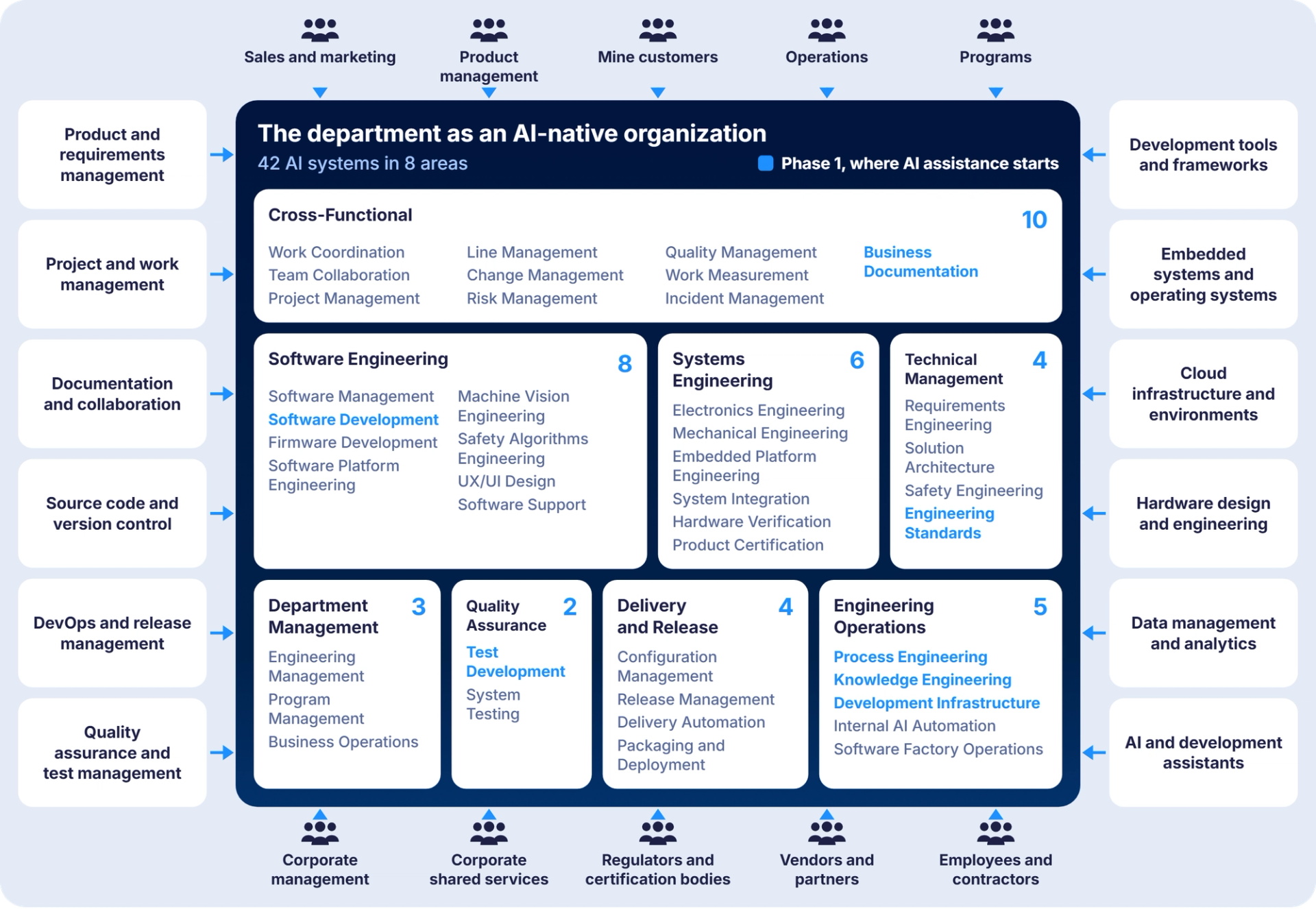
Because Boot Barn’s Development & Integration group would enable much of the company’s transformation, EIC also developed a complementary department-level strategy, from AI-assisted engineering to an integrated AI-powered Software Factory.
Together, the strategies connected enterprise ambition with the engineering capability required to execute it.
The sequence establishes a controlled progression from AI assistance toward supervised and selectively autonomous execution. People retain accountability for consequential financial, workforce, customer, supplier, legal, security, and strategic decisions.
This target state was represented by a blueprint of 114 candidate AI systems across 10 areas. Each system was connected to the business responsibilities, knowledge, data, enterprise applications, other systems, and human oversight it would require.
Organizational structure, enterprise systems, existing automation, business documentation, and a focused interview of approximately 105 minutes with the client champion.
Major business functions, operating activities, knowledge dependencies, enterprise systems, existing AI capabilities, and areas still dependent on manual work.
How AI-driven execution would interact with people and existing business systems while respecting human decision authority.
Common five-point scoring frameworks for every system, with the prerequisites and dependencies that separate long-term opportunities from feasible starting points.
Foundational capabilities before complex automation, preserving existing system investments, with a separate roadmap for Development & Integration.
Stakeholder responsibilities, required controls, baseline metrics, success criteria, funding decisions, and readiness requirements before implementation could begin.
The engagement completed the AI strategy and planning work. No production pilot had yet been evaluated, so operational cost savings, productivity increases, and implementation ROI were not measured outcomes of this engagement.

58 scored between 2.33 and 2.67, and 14 scored at 2.00 or below. These are relative implementation-readiness assessments, not confirmation that systems are approved or immediately deployable.
Sequenced according to value, readiness, and dependencies, from foundational capabilities to business-domain automation.
The Development & Integration plan introduces AI assistance across 9 systems in its first quarter and progresses toward the defined target automation levels for all 38 by its tenth quarter.
AI-assisted Business Analysis and Solution Architecture would convert an approved business need into structured requirements and architecture outputs, with human approval of final decisions. It is measured on preparation time, throughput, output quality, rework, human intervention, adoption, and governance compliance.
Comparable AI investment decisions. Business value, implementation readiness, and dependencies inform investment decisions instead of independent proposals or competing sponsorship.
Enterprise-wide transformation alignment. Business and technology leaders share one picture of the target operating model, the AI systems required across departments, and how the transformation should progress.
A practical path to scalable growth. Specific transformation opportunities intended to increase operating capacity without proportional increases in manual coordination and staffing.
Actionable next investment. A bounded opportunity to test AI-assisted execution, measure performance, establish reusable practices, and inform subsequent investment decisions.
Leadership gained a common view of candidate AI systems, their relative business value, implementation readiness, dependencies, human-control requirements, and planned progression. Translating this strategic model into day-to-day operations remains the responsibility of subsequent implementation, adoption, and governance activities.
The service behind this storyAI Organization Strategy →

“We had AI initiatives coming from several directions and no way to compare them. Now there is one list, an order with the reasons written down, and a first pilot we can start. And the point is growth: the same team running a bigger company.”
In a free consultation, we can review your existing AI initiatives and discuss how to turn them into a prioritized transformation plan.